 Speedy UK Deliveries
 100% SECURE PAYMENT
 VOLUME DISCOUNTS
 Contact us
Speedy UK Deliveries100% SECURE PAYMENTVOLUME DISCOUNTSContact us
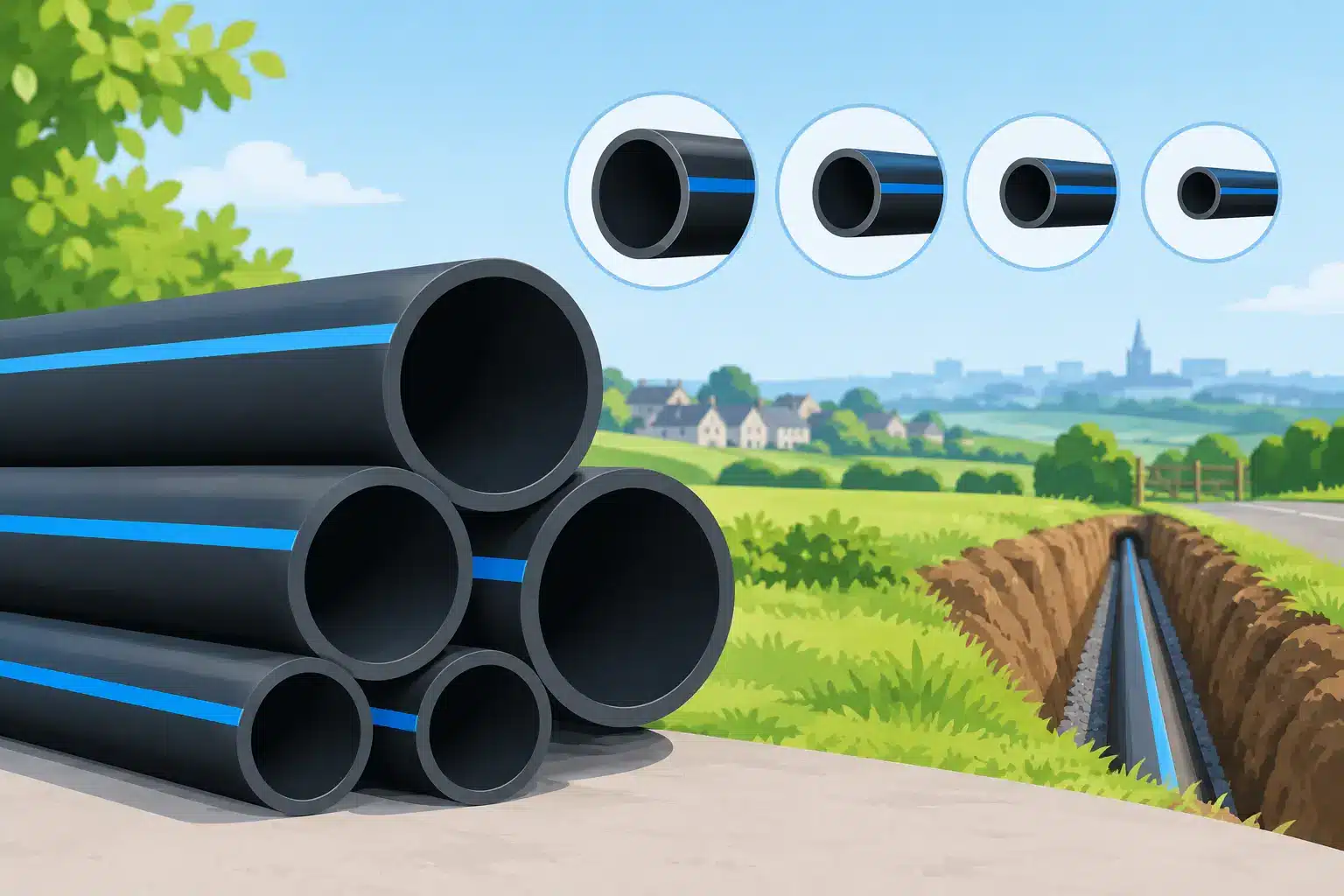
A water main is not the place to choose pipe by price alone. The wrong diameter can leave a property with disappointing flow, while the wrong pipe rating or fittings can create an avoidable leak below ground. If you are asking which MDPE pipe for mains is right for a UK installation, start with the type of supply, the pipe run and the specification required by the relevant water company.
For most domestic private cold-water supply runs, blue WRAS-approved MDPE is the normal choice. However, its diameter, pressure rating and connection method must suit the job. A short replacement from a boundary box is very different from a long supply run serving a large house, farm building or commercial unit.
MDPE means medium-density polyethylene. It is a tough, flexible plastic pipe widely used for buried potable-water service pipes and private mains. Blue MDPE is readily recognised on site as drinking-water pipework and is commonly supplied in coils, which reduces the number of joints needed on longer runs.
For a potable-water installation, select pipe that is clearly stated as suitable for drinking water and WRAS approved where required. WRAS approval confirms that the product has been assessed for use with wholesome water under the UK Water Fittings Regulations. This matters not only for compliance, but also for confidence that pipe and fittings are intended for the application.
Do not confuse blue MDPE water pipe with black alkathene-style pipe, agricultural pipe or drainage pipe. They may look broadly similar from a distance, but material grade, approval, pressure capability and intended use can differ. A water main needs a properly specified water-supply system, including compatible mechanical or electrofusion fittings.
Pipe diameter is usually the first decision. UK domestic MDPE water pipe is commonly available in 20mm, 25mm, 32mm and 63mm outside diameters. The correct option depends on demand and friction loss over the length of the run, rather than simply the size of the existing stop tap.
20mm pipe can suit short, low-demand supplies, small outbuildings or sections downstream of a meter where the incoming supply and water company requirements allow it. It is not normally the first choice for a new main feeding a typical house over any significant distance. The smaller bore creates more resistance to flow, particularly where there are several bends, a water meter or multiple outlets in use at once.
25mm blue MDPE is the familiar choice for many domestic service connections. It provides a practical balance between capacity, handling and cost for a standard home, especially where the distance from the boundary stop valve or meter to the property is modest.
That said, 25mm is not automatically right for every house. A long driveway, several bathrooms, a high-demand combi boiler, a large garden irrigation requirement or future extension plans may justify moving up a size. Check the water supplier’s approved connection detail before ordering, as some undertakers specify a minimum diameter for new service pipes.
32mm MDPE is a sensible choice where a private main is longer, demand is higher or preserving flow is a priority. It is often selected for larger homes, rural properties, shared private supplies and runs with a considerable distance between the meter and building.
The extra initial cost is usually modest compared with the disruption of digging up a finished drive or landscaped garden to replace an undersized pipe. A 32mm pipe does not create more incoming pressure, but its larger bore can reduce pressure loss along the run. This is particularly useful where available mains pressure is only moderate.
For commercial premises, farms, multi-unit developments or substantial private distribution mains, 63mm pipe and larger sizes may be required. At this point, the installation should be based on calculated demand, available pressure, route length and the water authority’s requirements. Larger pipe also needs appropriately rated fittings, valves and transition connections, so it is worth confirming the full system before work begins.
Diameter alone does not identify the correct mains pipe. MDPE pipe is also supplied with a pressure classification, often expressed as a pressure rating in bar and an SDR value. SDR, or Standard Dimension Ratio, compares the pipe’s outside diameter with its wall thickness. A lower SDR means a thicker wall for the same outside diameter.
Many domestic blue MDPE water pipes are supplied at 12 bar, which is suitable for common buried service-pipe applications. However, always check the marking on the pipe and the product specification. The selected rating must suit the working pressure, any pressure fluctuations and the installation conditions.
Do not assume a higher bar rating is automatically necessary or that all blue pipe has the same rating. If the supply has a pressure-reducing valve, booster equipment, a long rising main or unusual site conditions, obtain advice from the designer, installer or water company. The pipe, fittings and valves should all be suitable for the same duty.
A reliable water main is planned around its route. Measure the full distance from the connection point to the internal stop tap, allowing for changes in direction and a sensible amount of spare pipe. Coiled MDPE is ideal for reducing buried joints, but a coil must be handled carefully to avoid kinks. A kinked section can restrict flow and may need to be cut out rather than forced straight.
Buried pipe should be installed at the depth required by the local water company and protected from frost, accidental damage and contamination. In many domestic situations this means a trench deep enough to provide cover, with the pipe laid on suitable bedding and backfilled carefully without sharp stones bearing against it. The precise depth and separation distances from drains, sewers, electric cables and gas services must follow the utility provider’s requirements.
Where the pipe passes through a wall or enters a building, use a suitable duct or sleeve and seal the entry point correctly. Avoid burying unnecessary mechanical joints where a continuous length of pipe can be used. If a joint is unavoidable, keep it accessible where possible and use a fitting designed for underground potable-water use.
Your pipe is only as dependable as the components connected to it. MDPE compression fittings are widely used for domestic installations because they are straightforward to assemble and available as couplers, elbows, tees, reducers and adaptors. Use the fitting size that matches the pipe’s outside diameter – 25mm pipe needs 25mm MDPE connections, for example.
A typical service-pipe installation may also require an internal stop tap, external stop valve or boundary-box connection, pipe inserts where specified by the fitting manufacturer, and an adaptor to connect MDPE to copper, brass or threaded fittings. Do not mix components without checking compatibility. Inserts, liners and compression fittings are not interchangeable across every pipe type or manufacturer.
Before backfilling, test the completed section in line with the relevant installation requirements. This is the time to identify a poorly seated pipe end, a missed insert or a damaged fitting – not after a driveway has been reinstated.
For a new connection to the public network, the water undertaker has the final say on the section connecting to its mains and often on the private service-pipe specification too. It may set requirements for diameter, approved materials, trench depth, ducting, meter location and inspection before connection.
This is especially relevant on new builds, conversions and properties with a new boundary connection. Confirm the requirements before excavation and before ordering pipe, even if a neighbour’s installation looks similar. Local standards and available network pressure can vary.
For an existing private supply, replacement work may be more flexible, but it is still good practice to use WRAS-approved blue MDPE and size the pipe for present and foreseeable demand. If you are replacing old lead or galvanised pipe, increasing the diameter can be one of the most worthwhile improvements you make to the supply.
Before choosing MDPE pipe for a mains run, establish the connection type, total route length, required outside diameter, pressure rating and whether the water supplier has issued a specification. Then order enough matching fittings, valves, inserts and pipe protection to complete the route without substitutions on site.
For many standard domestic jobs, 25mm or 32mm WRAS-approved blue MDPE with compatible fittings will be the starting point. Where flow rate, distance or commercial demand is uncertain, choose the pipe only after the requirements have been checked. Getting the size right before the trench is filled is the simplest way to protect both water performance and the value of the installation.









 Sign in
