 Speedy UK Deliveries
 100% SECURE PAYMENT
 VOLUME DISCOUNTS
 Contact us
Speedy UK Deliveries100% SECURE PAYMENTVOLUME DISCOUNTSContact us
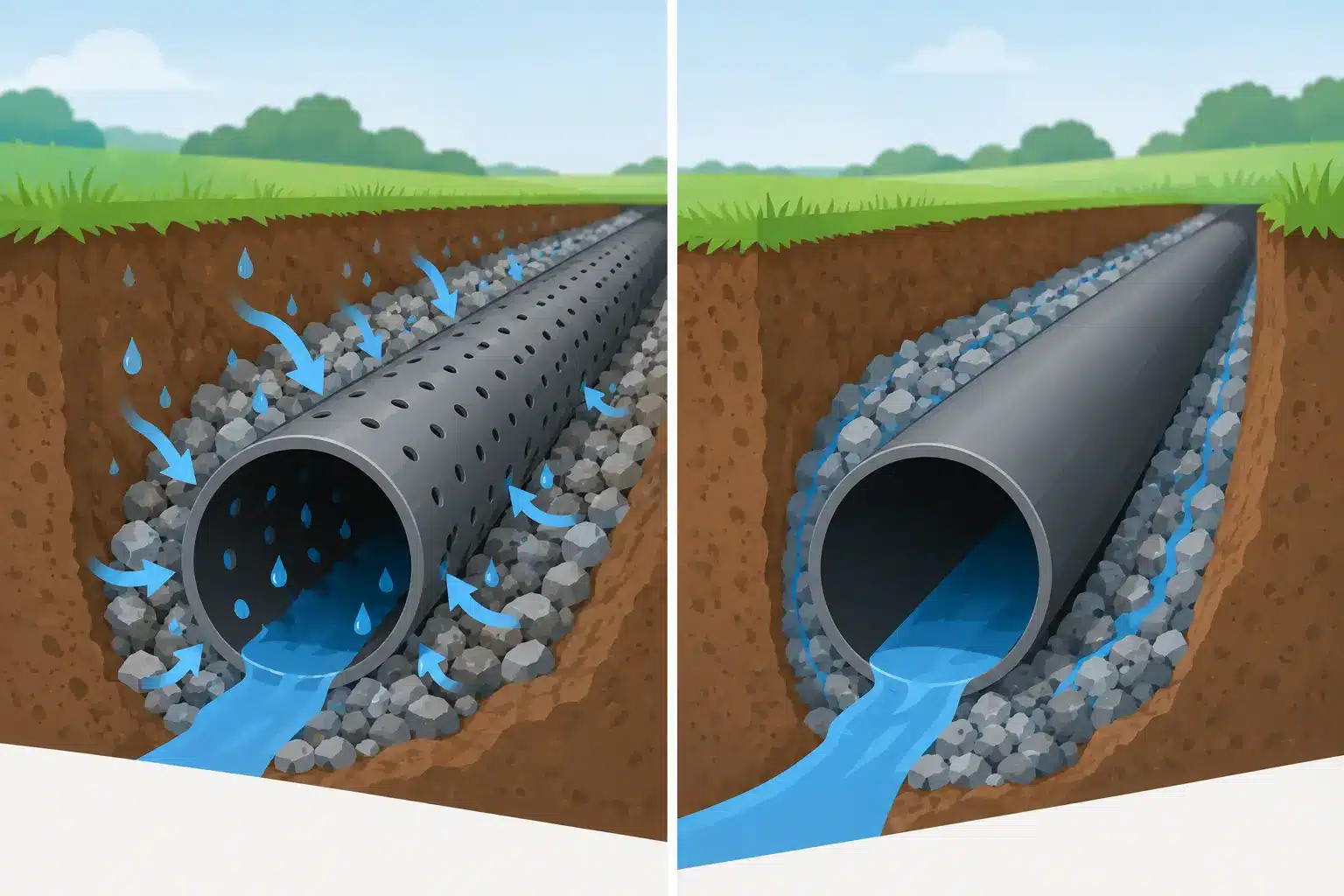
A land drain that is perfect for a wet lawn can cause problems if it is used to carry collected water to an outfall. The choice between perforated versus unperforated land drain is not simply about pipe type or price. It comes down to one practical question: do you need the pipe to collect water from the ground, or move water from one point to another?
Getting that distinction right helps prevent saturated ground, blocked runs and water discharging where it should not. It also makes ordering simpler, whether you are draining a domestic garden, protecting an extension footing, improving agricultural ground or installing a larger commercial drainage system.
Perforated land drain has slots or holes along its length. These openings allow groundwater to enter the pipe through the surrounding gravel and be carried away. It is designed for collection, making it the usual choice where water needs to be drawn out of soil.
Unperforated land drain has a solid wall with no openings. It cannot collect groundwater, but it provides a closed route for water already inside the system. It is used to convey water from a perforated section to a suitable discharge point, such as a soakaway, ditch, attenuation area or approved surface-water connection.
The two products often work together. A perforated run is installed across the wet area, then connected to an unperforated carrier pipe before the drainage leaves that area. Treating them as interchangeable is one of the most common causes of poor drainage performance.
Use perforated pipe where groundwater is the problem. Typical examples include soft, waterlogged lawns; agricultural fields; sports pitches; landscaped areas; retaining-wall drainage; and ground around buildings where a designed land-drainage system is required.
Water enters through the slots as it moves through the aggregate surround. The pipe then creates a lower-resistance route for that water to travel towards an outlet. It does not actively pull water from the ground. For the system to work, the trench, stone surround, pipe level and discharge point all need to be properly planned.
Perforated pipe is normally laid with a consistent fall towards the outlet. In relatively flat ground, the fall may be modest, but the pipe must not rise and fall unpredictably. Low spots can hold silt and standing water, reducing capacity over time.
Use unperforated pipe when the aim is to transport collected water without allowing more water in or leaking water back into the ground. This is especially useful between a field drain and a ditch, from a French drain to a soakaway, or where water is being taken past an area that should remain dry.
A solid pipe is also the sensible option where a drainage route passes close to foundations, paths, driveways or other structures. Allowing water to escape from a perforated pipe in these locations can soften subsoil, wash out fines or create damp patches exactly where they are least wanted.
If you are connecting a land-drainage system into conventional underground drainage components, check diameter and connection compatibility before ordering. Land-drainage coil, rigid underground pipe and fittings can have different outside dimensions, coupling arrangements and stiffness ratings.
The simplest way to specify a system is to follow the water from source to outfall. Where rainwater is held in the soil, start with perforated land drain. Where that water needs to cross dry ground or travel to a discharge point, change to unperforated pipe.
For example, a garden that remains wet after heavy rain may need several perforated lateral runs feeding into a collector. Once the collector reaches the edge of the garden, an unperforated length can take water to a correctly sized soakaway. In an agricultural setting, perforated laterals can feed a solid main run leading to a ditch or approved outlet.
Do not use land drain as a substitute for a surface-water pipe where roof water is concentrated into gutters and downpipes. Roof drainage can produce high volumes quickly. It usually needs a properly designed solid surface-water system, with gullies, chambers and an appropriate outlet. Perforated pipe can allow concentrated roof water to escape into the surrounding ground before it reaches its intended destination.
Land drainage must never be used for foul water. Foul and surface-water arrangements have different requirements, and any connection to a public sewer or watercourse must be agreed with the relevant authority.
A perforated land drain only works as well as its trench construction. The usual approach is to excavate to the required line and level, install a geotextile filter membrane where ground conditions call for it, place clean angular drainage aggregate, lay the pipe, then surround and cover it with more aggregate before wrapping or lapping the membrane as specified.
The aggregate creates voids that let groundwater reach the perforations. Clean, angular stone is generally preferred because it provides a stable, free-draining surround. Fine soil placed directly against the pipe can enter the slots, while clay-heavy spoil can restrict water movement and shorten the system’s useful life.
Filter membrane is there to keep surrounding soil fines out of the aggregate. It is not a replacement for gravel, and it should not be used as an impermeable liner around a land drain. Wrapping a perforated pipe in the wrong material can stop water entering it or encourage silting.
Unperforated sections need equally careful bedding, support and jointing. They should be protected from point loads and installed at a reliable gradient. Where traffic will pass above the route, choose a pipe system and cover depth suitable for the loading conditions. Flexible coil is convenient for long sweeping runs, while rigid pipework and fittings can offer more controlled alignment and access arrangements where changes of direction are needed.
There is no single correct depth for every land drain. The required depth depends on what is being drained, the soil profile, nearby foundations, cultivation depth, frost risk, existing services and the level of the final outlet. A shallow garden drain may improve turf conditions, while a system intended to intercept groundwater near a structure requires more careful design.
The outlet is the part that deserves attention before any trench is dug. Water cannot drain uphill, and a soakaway must be suitable for the ground conditions and the volume it will receive. Discharge to a ditch, watercourse or sewer may require permission. For work near buildings, public drainage or highways, check the relevant Building Regulations, local authority requirements and site-specific drainage design.
Provide access points or rodding arrangements on larger systems and at significant direction changes where practical. Land drains inevitably deal with silt, roots and natural debris. A system that can be inspected and maintained is far easier to keep working.
The first mistake is installing perforated pipe all the way to the outlet. This may seem cheaper and easier, but it can lose water into the ground on the final run and leave areas wet. Change to a solid carrier section when collection is no longer needed.
The second is expecting perforated pipe to cure surface flooding without dealing with levels. If water is flowing across a patio, driveway or hardstanding, channel drainage, gullies and correctly positioned surface-water pipework may be the better answer. Land drain manages groundwater beneath the surface, not every visible puddle.
The third is choosing diameter by guesswork. A small domestic run may have very different needs from a long agricultural collector or a commercial landscaping scheme. Consider the catchment area, likely water volume, run length, gradient, number of laterals and discharge capacity. Larger diameters can carry more flow, but they also need compatible couplers, fittings and outlets.
Finally, do not bury unknown services. Check for water, gas, electric, telecoms and existing drainage before excavation. Keep new drainage routes clear of foundations and follow safe digging practice throughout.
For a straightforward installation, order the pipe with the components that make the route complete: suitable couplers, junctions or tees, end caps where required, inspection access, filter membrane and drainage aggregate. If the system passes from land-drainage coil into underground drainage pipework, confirm the adaptor arrangement rather than assuming two pipes of a similar nominal size will join directly.
Speedy Plastics supplies trade-ready drainage and water-management products for domestic, agricultural and commercial work, helping you source compatible pipework and fittings from one place at competitive prices. Select the system around the water path first, then choose perforated pipe for collection and unperforated pipe for controlled conveyance. That one decision gives the rest of the installation a sound starting point.









 Sign in
