Speedy UK Deliveries
 100% SECURE PAYMENT
 VOLUME DISCOUNTS
 Contact us
Speedy UK Deliveries100% SECURE PAYMENTVOLUME DISCOUNTSContact us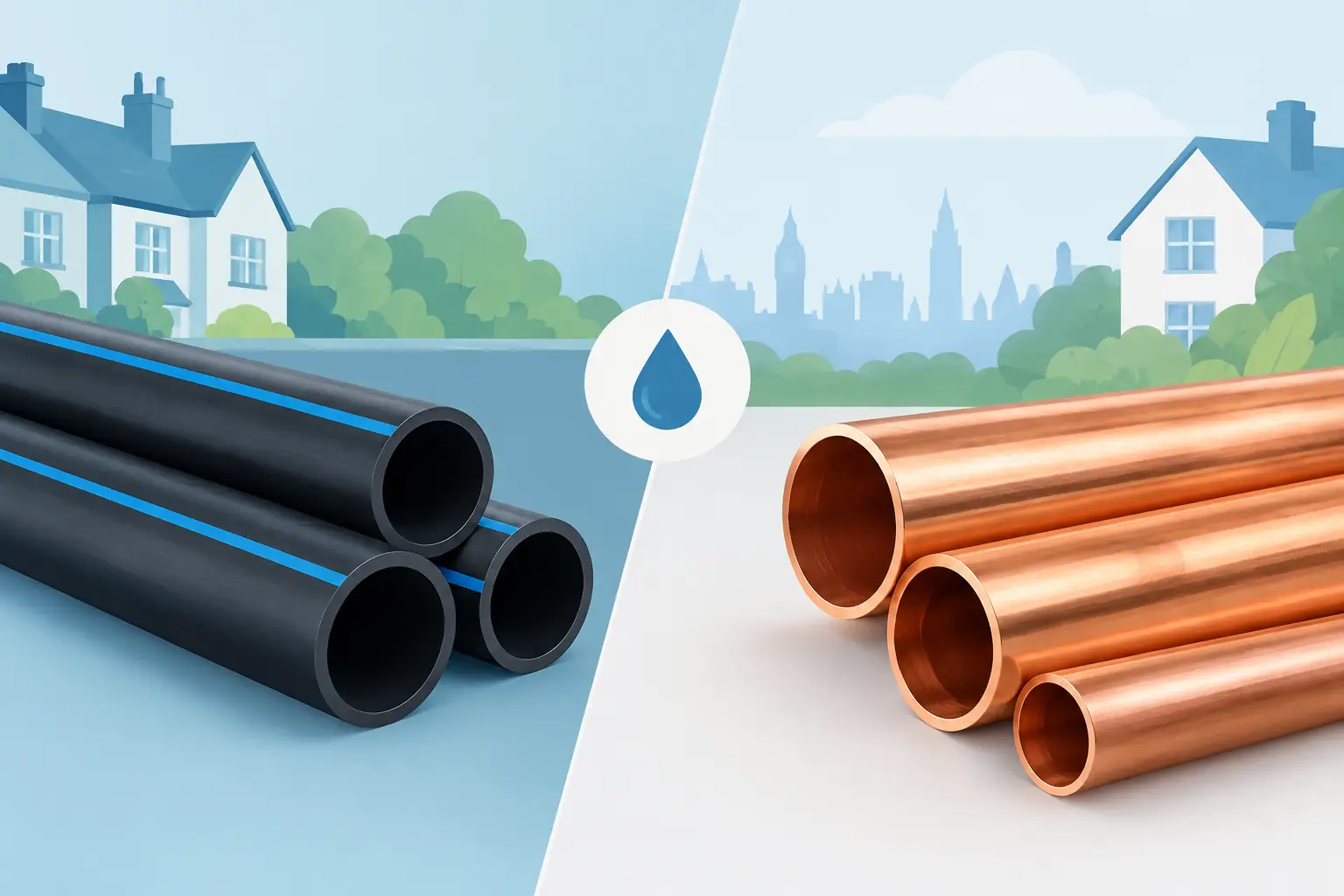
A new water supply run can look simple on a plan: pipe from the boundary to the building, then onward to the kitchen, utility room or plant area. In practice, choosing MDPE versus copper affects the installation method, fitting requirements, cost, future maintenance and whether the pipe is suited to its location.
For most UK projects, this is not an either-or decision. WRAS-approved MDPE is generally the practical choice for an underground cold-water service pipe, while copper remains a familiar and capable option for exposed internal pipework and hot-water services. The right material depends on where the pipe runs, what it carries and how it will be protected.
MDPE, or medium-density polyethylene, is a flexible plastic pressure pipe commonly used for underground potable-water mains. Blue MDPE water pipe is supplied in coils or straight lengths and is available in common sizes including 20mm, 25mm, 32mm, 50mm and 63mm. Its flexibility makes it well suited to long service runs with fewer joints.
Copper is a rigid metal pipe used widely in domestic and commercial plumbing. It is available in several diameters and wall thicknesses, and can be joined with soldered, compression or press fittings. Copper is suitable for hot and cold water when correctly specified, which gives it a broader role inside a building.
The practical distinction is straightforward. MDPE is designed to make below-ground cold-water installation faster and less joint-heavy. Copper is often selected where pipework needs to remain neat, accessible, heat-resistant and mechanically secure above ground.
For a new or replacement external water main, MDPE is normally the sensible starting point. A coil can run from the stop tap or meter position to the property with very few connections. Fewer buried joints reduce potential leak points and save time during installation.
MDPE is also resistant to corrosion. Soil conditions that may gradually affect metallic pipework do not create the same concern with plastic water pipe. It is lightweight to handle, particularly on domestic plots where a small team or capable DIY customer is working without lifting equipment.
A 25mm or 32mm MDPE service pipe is common for domestic supply work, although the required diameter should be based on water demand, available pressure, pipe-run length and the requirements of the water supplier. Larger properties, annexes, agricultural buildings and commercial premises may need a larger diameter to avoid excessive pressure loss.
For potable-water installations, select WRAS-approved pipe and compatible fittings. Blue MDPE indicates a potable-water application, but colour alone is not a substitute for checking the product specification and approval status.
MDPE should be installed below the frost-protection depth required for the site and local water authority guidance. It also needs proper support and protection where it enters a building, crosses a wall or passes through a duct. Above ground, ordinary blue MDPE should not be left exposed to prolonged sunlight unless the manufacturer confirms it is suitable for that use.
MDPE does not use the same joining methods as copper. Connections are usually made with purpose-made compression fittings, typically using a liner or pipe insert inside the pipe end where required by the fitting manufacturer. The pipe must be cut square, fully inserted and tightened correctly.
This is one area where installers should not mix components carelessly. Use fittings rated for the pipe size, material and pressure application, and check whether an insert is supplied or needs to be ordered separately. A poor connection may hold initially but become a problem after backfilling or pressure changes.
Where an MDPE service pipe connects to internal plumbing, use an approved transition fitting. The connection should remain accessible where possible, rather than being concealed in a wall or buried without suitable provision for inspection.
Copper comes into its own inside the property. It is suitable for hot-water distribution and is often preferred for visible pipework in cupboards, utility rooms, boiler areas and commercial plant spaces. It holds a straight line, can be clipped neatly and is less vulnerable to incidental knocks than flexible plastic pipe when installed correctly.
Unlike standard MDPE water pipe, copper can carry hot water. That makes it suitable for connections around cylinders, boilers and hot-water outlets, subject to the system design and the requirements of the appliance manufacturer. Standard blue MDPE should not be used as a replacement for internal hot-water pipework.
Copper can also be a practical option where a short external section must be exposed, provided it is protected from frost and corrosion as necessary. It does, however, require more joints on a long route. Every elbow, coupling and branch is another fitting, another installation step and another point that must be made properly.
The material cost is usually higher than MDPE, and copper prices can move significantly. Labour can also be higher where pipework involves numerous bends, soldered joints or careful routing through an occupied property. For a short, tidy internal alteration, this may be worthwhile. For a 30-metre trench run to a house, it usually is not.
Copper has a long service record, but it is not immune to every site condition. Aggressive water chemistry, poor installation practice, contact with incompatible materials and unprotected pipework in corrosive surroundings can all shorten service life. Any copper pipe installed below ground requires appropriate protection and should not simply be treated as a direct substitute for MDPE service pipe.
This is particularly relevant on renovation projects. If replacing an older lead or steel supply, inspect the full route rather than changing only the visible section. A new copper tail connected to a deteriorating buried pipe does not solve the underlying supply issue.
MDPE generally provides the lower-cost route for underground cold-water work. The pipe is lighter, transport is easier and a coil allows installers to cover distance quickly. On an open trench, the saving is not only in pipe price but also in the reduced number of fittings and joints.
Copper may be more economical on very short internal runs, especially where an installer already has the tools, fittings and existing copper system to match. It can also avoid an unnecessary material transition in a small repair. However, as the route becomes longer or more complex, the value case for MDPE below ground becomes clearer.
Installation conditions matter. MDPE is flexible, but that does not mean it can be pulled around sharp corners or kinked into position. Respect the manufacturer’s minimum bend radius. Copper is rigid, so accurate measuring and bending are essential to prevent a route becoming untidy or placing strain on fittings.
Both materials need careful clipping, sleeving and protection at penetrations. Neither should be chosen simply because it is familiar. The best installation is the one that uses the right pipe for the service, with compatible fittings and a route that can be inspected or maintained where needed.
Standard MDPE is not always suitable for every buried-water application. On sites with known or suspected hydrocarbon contamination, such as former garages, industrial land or areas near oil storage, a barrier pipe system may be required. These pipes are designed to reduce the risk of contaminants permeating the water supply.
Do not assume that deeper burial or a protective duct makes standard pipe suitable in contaminated ground. The project specification, water authority requirements and site assessment should determine the pipe system. This is a situation where selecting the cheapest standard pipe can create an expensive problem later.
For a new domestic mains run from the boundary to the house, use correctly sized WRAS-approved MDPE and compatible compression fittings. For cold-water pipework within the building, either copper or an appropriate internal plumbing system may suit the layout. For hot-water services and exposed pipework around appliances, copper remains a dependable option when properly installed.
If the job crosses several areas – trench, wall entry, utility room and cylinder cupboard – plan the transitions before ordering. Check diameters, fitting types, inserts, stop taps, ducting, insulation and pipe protection together. That approach keeps the water supply compliant, avoids last-minute fitting mismatches and gives the finished installation a far better chance of staying trouble-free for years.