Speedy UK Deliveries
 100% SECURE PAYMENT
 VOLUME DISCOUNTS
 Contact us
Speedy UK Deliveries100% SECURE PAYMENTVOLUME DISCOUNTSContact us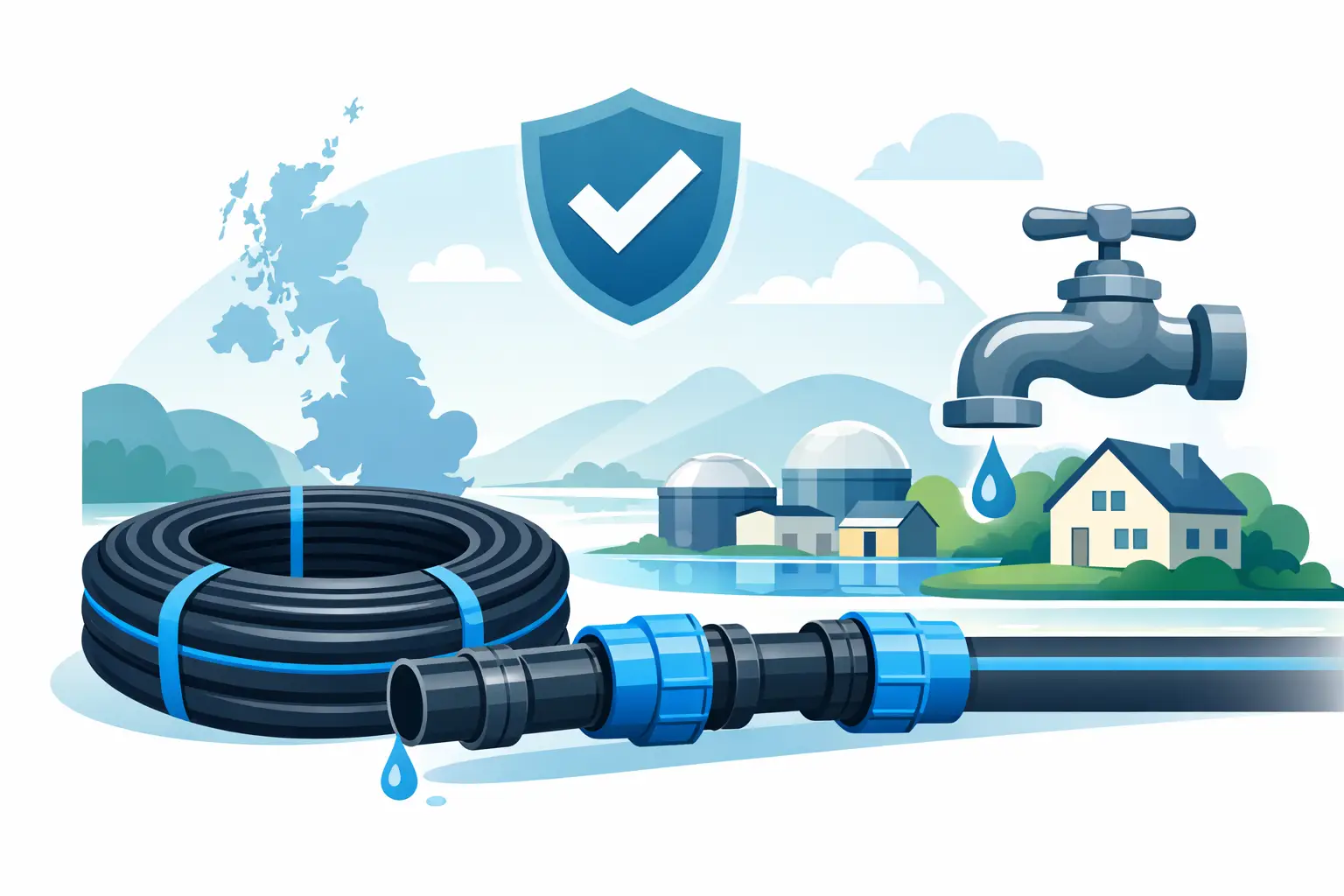
A new water supply can look straightforward on a plan, but the pipe chosen below ground affects compliance, water quality and how easily the job can be signed off. WRAS approved MDPE pipe is the standard choice for carrying potable cold water to homes, outbuildings, commercial units and agricultural facilities, provided the pipe and associated fittings are suitable for the planned installation.
MDPE, or medium-density polyethylene, combines flexibility with the strength needed for buried service pipes. It is supplied in blue for potable water applications, making it easier to identify on site and distinguish from black irrigation pipe, yellow gas pipe and drainage systems. For installers, that clear identification matters when several services share the same project.
WRAS stands for the Water Regulations Approval Scheme. An approved product has been assessed as suitable for contact with wholesome water and compliant with the relevant requirements of the UK Water Supply (Water Fittings) Regulations and Scottish Byelaws. In practical terms, it gives contractors, plumbers and property owners confidence that the material will not adversely affect the water supply when used as intended.
Approval is not a substitute for correct installation. A WRAS-approved pipe still needs compatible fittings, proper jointing, suitable protection and an installation that meets the requirements of the local water undertaker. It also does not mean every blue plastic pipe is automatically approved. Always check the product description, markings and certification for the particular pipe, fitting or valve being purchased.
This distinction is especially useful on jobs where the supply runs from the boundary stop tap to a new property, annexe, workshop or livestock building. The pipe is only one part of the system. Compression fittings, stop taps, service valves and any internal transition fittings must also be appropriate for drinking-water use.
Blue MDPE water pipe is designed for cold-water supply rather than hot-water distribution. It is commonly installed as the incoming mains service pipe from the meter or boundary connection, then brought into the building before changing to a suitable internal plumbing system.
Typical uses include domestic new-builds and extensions, replacement lead or ageing service pipes, garden buildings with a permanent water supply, commercial premises, farms, washdown points and irrigation connections where potable water compatibility is required. It is also useful where a long run would be awkward with rigid pipe, as coils reduce the number of buried joints.
The application still determines the right specification. A short supply to a garden tap has different flow requirements from a main serving several bathrooms, a workshop and an external hydrant point. Pipe diameter, pressure class and route should be considered before ordering rather than selected purely on the lowest initial cost.
For domestic service work, 25mm and 32mm MDPE are frequent choices. A 25mm pipe can suit modest flows and shorter runs, while 32mm gives greater capacity and is often selected where the run is longer or demand is higher. Larger diameters such as 40mm, 50mm and 63mm are used for commercial, agricultural and multi-property applications where calculated demand requires more flow.
There is no universal best size. A larger pipe can reduce pressure loss over distance, but it costs more and needs correspondingly sized fittings. Existing connection size, incoming pressure, expected simultaneous use and the water supplier’s requirements all need to be checked. Where pressure or flow is uncertain, obtain advice before trenching and before committing to pipe size.
Start with the intended use: potable cold water, not drainage, not gas and not a hot-water circuit. Then confirm the pipe’s stated pressure rating and diameter. MDPE pipe is commonly supplied in coils for straightforward handling, with longer coils helping minimise underground couplers on long routes.
Use fittings made for the pipe diameter and pressure range. Mechanical compression fittings are widely used with MDPE because they create a reliable demountable connection when assembled correctly. Most installations require a correctly sized pipe insert or liner inside the MDPE end before tightening the fitting. The insert supports the pipe wall and helps the compression joint retain its shape under pressure.
Cut the pipe squarely and remove any burrs or damage before fitting. Do not force a distorted pipe end into the fitting, and do not overtighten in an attempt to cure a poor cut or missing insert. Follow the fitting manufacturer’s assembly instructions, including any guidance on lubrication, pipe depth marks and tightening.
Where the pipe enters a building, use a suitable transition arrangement and protect it from damage at the point of entry. A service duct or sleeve may be needed depending on the installation detail. Avoid mixing unrelated systems simply because the diameters appear similar. Water pipe, electrical ducting and drainage components are designed for different purposes and are not interchangeable.
Good preparation prevents expensive faults once the route is covered. Establish the service route first and check for existing utilities. Water pipe should be installed at a depth that protects it from frost, traffic loading and accidental damage, but the required depth can vary by location and water supplier. Follow the relevant utility drawings and local requirements, particularly for crossings, driveways and shared service corridors.
The trench base should be free from sharp stones, rubble and other objects that could point-load the pipe. Lay the pipe carefully without severe kinks or unnecessary strain, then provide suitable surround material before backfilling. Where the route crosses contaminated ground or an area with a known risk of hydrocarbons, standard MDPE may not be the appropriate choice. A barrier pipe system may be required to protect drinking-water quality.
Keep the pipe route clear of heat sources and avoid using MDPE for hot-water distribution. It is a cold-water mains product, and using it outside its stated application can shorten service life and create compliance problems.
Before the trench is closed, pressure-test the new section in line with the project specification and applicable requirements. Check every joint, valve and transition fitting. It is far quicker to correct a weep at this stage than to reopen a driveway, landscaped area or finished floor later.
When ordering WRAS approved MDPE pipe, confirm the diameter, coil length and pressure rating first. Match every fitting to that size, and include pipe inserts, stop taps, connectors and protective ducting or sleeves where the route requires them. For a supply entering a building, plan the transition to the internal plumbing material rather than treating it as an afterthought.
For larger projects, it is worth ordering the full connected system at the same time. Pipe, compatible fittings, valves and any required chambers or ducting can then be checked together before work starts. This reduces delays caused by a missing insert, an incorrect reducer or a fitting from the wrong pipe system.
Price matters, but so does traceability. Product markings, recognised approvals and clear application information make it easier to specify the correct materials for a professional installation. Speedy Plastics supplies trade-ready water mains pipe and fittings alongside the drainage and service products often needed on the same job, with competitive VAT-inclusive pricing and UK delivery.
A compliant water supply starts below ground, where shortcuts are hardest to put right. Choose the approved pipe for the application, size it for real demand and install it with fittings designed to do the same job.