 Speedy UK Deliveries
 100% SECURE PAYMENT
 VOLUME DISCOUNTS
 Contact us
Speedy UK Deliveries100% SECURE PAYMENTVOLUME DISCOUNTSContact us
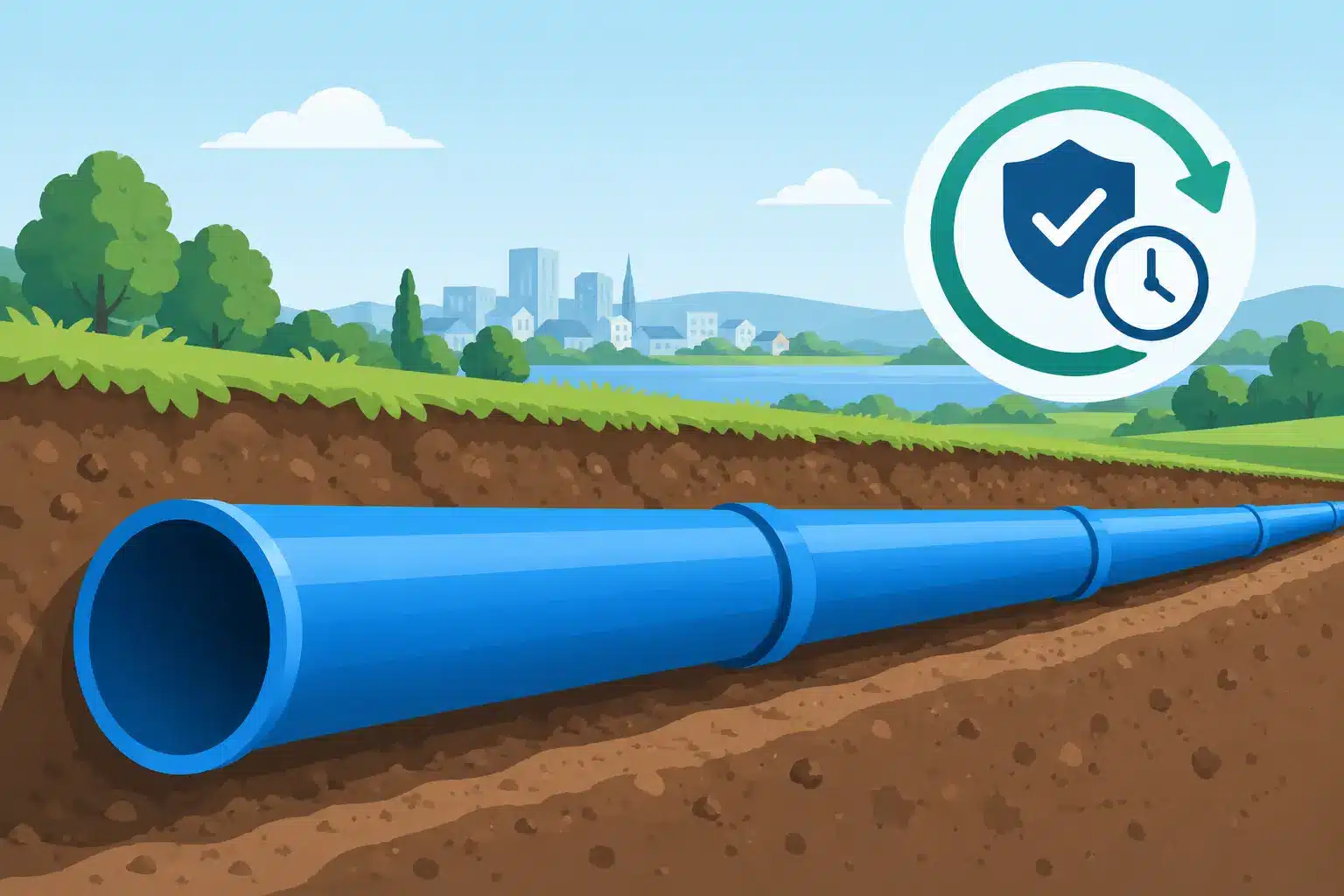
A water supply pipe is usually buried, out of sight and expected to work without attention for decades. That makes MDPE pipe lifespan a specification issue, not simply a question of choosing the lowest-cost coil. For a correctly selected and installed potable-water system, quality MDPE pipe is commonly designed for a service life of 50 years or more. However, that expectation depends on pressure, temperature, installation quality and protecting the pipe from damage.
For domestic connections, agricultural supplies and many commercial cold-water installations, MDPE remains a practical choice because it is flexible, corrosion-resistant and available with compatible fittings. The key is to treat the pipe, fittings, valves and installation method as one system.
MDPE, or medium-density polyethylene, is used for cold-water supply because it does not rust, is not affected by limescale in the way some metal pipework can be, and tolerates normal ground movement well. Blue MDPE water pipe is widely used for underground potable-water services where a suitable WRAS-approved product is required.
A 50-year design life is the usual benchmark quoted for properly manufactured polyethylene pressure pipe operating within its stated conditions. It is not an unconditional guarantee that every installation will last exactly 50 years. A pipe carrying cold water at its correct working pressure, installed below ground with suitable bedding and protection, has a very different operating environment from one left exposed to sunlight, crushed by poor backfill or repeatedly subjected to pressure surges.
The pipe’s pressure rating matters. MDPE is supplied in ratings such as PE80 and PE100, with pressure capability determined by the product specification, wall thickness and diameter. Do not assume that a larger diameter automatically means a higher pressure capacity. Always match the pipe to the system pressure and confirm that the selected fittings are rated for the same application.
Steady pressure within the manufacturer’s stated limits is what an MDPE system is designed to handle. Repeated over-pressure, water hammer and pump start-up surges place extra stress on the pipe wall and joints. This is particularly relevant on pumped agricultural, irrigation or private-water systems.
A pressure-reducing valve, correctly sized pump controls and measures to limit water hammer can protect the whole installation. It is sensible to account for the maximum likely pressure, not just the normal pressure shown on a gauge during quiet operation.
MDPE is intended principally for cold-water services. Higher temperatures reduce the long-term pressure performance of polyethylene, so it should not be substituted for pipework designed for hot-water distribution. Keep it away from boilers, uninsulated hot pipes and other heat sources unless the full system specification permits that use.
Above ground, ultraviolet exposure is another consideration. Short periods during storage or installation are unlikely to be the main concern, but permanent exposure to direct sunlight can shorten service life depending on the pipe type and its UV stabilisation. Where pipework must run externally, use a product specified for the exposure or provide suitable protection. Avoid leaving coils on site for extended periods in strong sun when they can be stored under cover instead.
MDPE is flexible, but it is not immune to physical damage. Sharp stone, broken brick, concrete waste and poorly compacted backfill can create local stress points. A stone pressed against the pipe may not cause an immediate leak, yet it can compromise a pipe that is expected to remain in service for decades.
Excavate a trench that allows the pipe to sit without being forced around obstructions. Remove sharp material, provide an appropriate fine bedding where ground conditions require it, then surround the pipe with selected fill before reinstating the trench. Follow the relevant installation guidance and local water undertaker requirements for depth, marker tape and separation from other services.
Ground contamination also deserves attention. In areas with known fuel, oil, chemical or contaminated-land risks, standard MDPE may not be the correct solution. Certain hydrocarbons can permeate some plastics. A specialist barrier pipe system may be required, particularly where the water main crosses or runs close to contaminated ground.
Frozen water expands and can damage fittings, valves and pipework. Underground MDPE should be installed at a depth that provides frost protection in line with the water supplier’s requirements and site conditions. There is no single depth that suits every property, because landscaping, traffic loading, climate and local guidance all matter.
Where a pipe rises above ground to enter a building, tank or outbuilding, that exposed section is more vulnerable than the buried run. Insulate it properly, avoid unprotected external stop taps where possible and make sure the pipe is not routed through an area that regularly freezes.
A durable length of pipe can still be let down by a poor joint. Compression fittings must be compatible with the pipe diameter and type, assembled in accordance with the fitting manufacturer’s instructions and tightened correctly. Many MDPE compression connections require a pipe insert or liner to support the pipe end. Leaving this out, using the wrong insert or cutting the pipe unevenly can increase the chance of leaks or joint movement.
Use a square, clean cut and remove burrs before making a connection. Check that the pipe is fully inserted to the fitting stop. Avoid excessive bending close to a joint, and support above-ground pipework so the fitting is not carrying the load of a long pipe run.
Electrofusion and other specialist jointing methods can be appropriate for larger or specified installations, but they demand clean surfaces, correct equipment and trained installation. The best jointing method depends on the pipe size, site access and project specification.
The first check is application suitability. For drinking-water connections, choose blue MDPE pipe clearly marked for potable-water use and with the approvals required for the job, such as WRAS approval where applicable. WRAS approval supports product suitability for contact with wholesome water, but it does not replace correct design or installation.
Next, select the diameter for the demand and length of run. A 20mm or 25mm pipe may suit a short domestic supply, while 32mm, 50mm or 63mm pipe may be more appropriate where greater flow is needed or the route is long. Undersizing can lead to poor flow and excessive pressure loss, while unnecessary upsizing adds material cost and may require different fittings. Calculate the requirement rather than matching the size of an old pipe without checking why it was selected.
Buy pipe and fittings intended to work together. This reduces uncertainty over tolerances and pressure ratings. A complete installation may also need stop taps, valves, pipe insulation, ducting for protected crossings and warning tape. Planning those items before excavation helps prevent improvised connections on site.
MDPE does not corrode internally, so an ageing pipe may show few visual signs before a problem develops. A sudden fall in pressure, an unexplained increase in water use, damp ground along the pipe route or a pump cycling more often than usual can all indicate a leak.
Inspect accessible sections for deep scoring, crushing, kinks, discolouration caused by unsuitable exposure or strain around fittings. Do not ignore a small weep at a compression fitting. It may be a simple issue such as a damaged olive, incorrect insert, poorly cut pipe end or movement in the pipework, but it should be repaired before water undermines surrounding ground or enters a building.
When excavating near an older supply, expose it carefully by hand around the pipe. A spade strike, aggressive mechanical digging or a heavy vehicle crossing a shallow service can cause damage that is not immediately obvious.
The lowest upfront pipe price is rarely the true cost of a water main. Re-opening a finished driveway, patio, field or landscaped garden to repair a failed pipe is where shortcuts become expensive. Specifying approved pipe, compatible fittings and sensible protection is normally a better investment than saving a small amount on materials.
For trade and DIY projects alike, measure the route accurately, allow enough pipe for a relaxed run into fittings and order the complete set of compatible components at the same time. Speedy Plastics supplies WRAS-approved MDPE water pipe and associated fittings for practical domestic and commercial water-service work.
A well-installed MDPE line should become the part of the project you no longer have to think about. Keep it within its pressure and temperature limits, protect it from frost and physical damage, and it can provide dependable cold-water service long after the trench has been reinstated.









 Sign in
