 Speedy UK Deliveries
 100% SECURE PAYMENT
 VOLUME DISCOUNTS
 Contact us
Speedy UK Deliveries100% SECURE PAYMENTVOLUME DISCOUNTSContact us
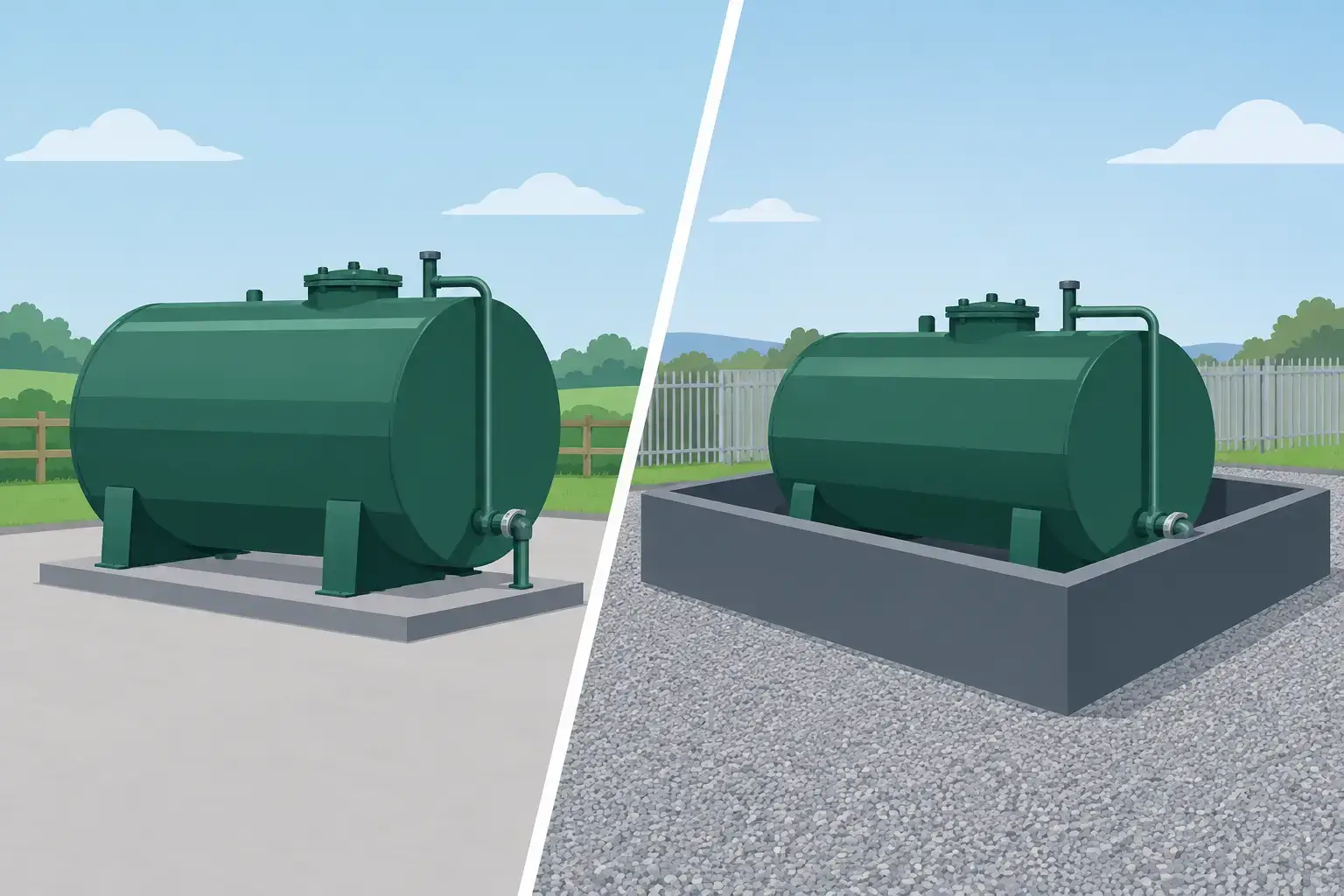
A replacement heating-oil tank can look like a straightforward purchase until its proposed location raises questions about spill protection, fire separation and access for deliveries. The choice between oil tanks versus bunded tanks affects more than the purchase price: it can determine whether the installation is suitable for the site, compliant with applicable requirements and protected against an expensive fuel loss.
For many domestic, agricultural and commercial installations, a plastic bunded oil tank is the sensible default. A single-skin tank can still be appropriate in the right low-risk setting, but only where the surrounding area, nearby drains and site conditions allow it. Getting this decision right before arranging installation avoids having to move a full tank later.
A standard single-skin oil tank has one tank wall. It stores heating oil, diesel or another compatible liquid in a single polyethylene vessel. If the tank is damaged, overfilled or develops a failed fitting, the stored fuel can escape directly into the surrounding area.
A bunded tank has a tank within an outer containment tank. The inner tank holds the fuel, while the outer layer forms a secondary containment area known as the bund. This bund is designed to retain a leak from the primary tank and is commonly specified to hold at least 110% of the inner tank’s capacity.
The principle is simple, but it matters on a real site. A split single-skin tank positioned near a surface-water gully, drain, watercourse or boundary can cause a serious pollution incident. A bunded model provides a second line of defence, giving the owner and installer time to identify and deal with a problem before oil reaches the ground or drainage system.
Single-skin oil tanks remain a practical option for some domestic properties, particularly where the installation area is open, level and well away from buildings, boundaries, drains and water sources. They are usually less expensive to buy than an equivalent bunded tank and can be easier to position where space is tight.
They also have a lower external footprint for a given fuel capacity. That can help when replacing an existing tank in a restricted side passage or a purpose-built enclosure, although clearance requirements still need to be checked carefully.
The lower upfront cost should not be the only consideration. A single-skin tank depends entirely on the integrity of its one wall, its outlets and its fittings. It is best suited to sites where the consequences of a leak are low and where the required separation distances and installation guidance can be met without compromise.
A single-skin tank may not be suitable where there is a nearby drain, a ditch, a stream, loose or sloping ground, or a building that increases the fire risk. The same applies where the tank serves business premises, a farm or a location with higher potential for accidental impact.
Bunded oil tanks cost more initially, but the extra material and containment can be worthwhile on almost any site with elevated risk. They are widely used for domestic heating oil, agricultural diesel, commercial fuel storage and waste-oil applications because the outer bund helps contain a primary-tank failure.
For homeowners, the most obvious benefit is reassurance. A bunded tank is particularly useful where a garden drain, driveway channel drain or inspection chamber is close to the proposed installation. Oil entering a drainage network is difficult and costly to clean up, even where the visible spill appears small.
For farms and commercial properties, secondary containment is often the more prudent specification. Plant movement, vehicles, deliveries and more frequent use all increase the likelihood of accidental knocks or damaged fittings. A bunded tank also offers better protection where a larger stored volume would make any leak more significant.
There is a practical buying point too. Choosing a bunded tank at replacement stage can offer more flexibility if the use of the property changes later. A house may become a rental property, a smallholding may add machinery, or an outbuilding may be converted into a workspace. Installing the higher-protection option from the outset can prevent a further tank change when site risk increases.
No tank should be selected in isolation from its location. Before choosing capacity or construction, assess the area around the proposed base. Look for drainage points, watercourses, boundaries, buildings, flues, overhead cables, vehicle routes and trees that could affect access or maintenance.
The tank needs a stable, non-combustible and level base that fully supports it. A poorly prepared base can cause the tank to settle unevenly as it fills, placing stress on the bottom of the vessel and connected pipework. Concrete or paving slabs laid on a properly prepared foundation are common options, provided the base is sized and constructed for the tank manufacturer’s requirements.
Fire separation is another key consideration. Oil tanks must be positioned with suitable separation from buildings, boundaries and ignition risks, or protected with an appropriate fire barrier where permitted. Exact requirements depend on the tank, fuel, building construction and local circumstances. Do not assume that an existing tank location is automatically acceptable for a replacement installation.
Delivery access also deserves early attention. The fuel supplier needs safe access to the fill point, while the installer needs room to manoeuvre the empty tank and connect the supply line. A larger capacity tank may reduce delivery frequency, but it is only useful if it can be installed, inspected and filled safely.
Capacity should reflect realistic consumption rather than simply buying the largest tank that fits. A domestic property using heating oil may benefit from enough storage to avoid running low during winter, while a farm or business may need capacity based on machinery use, delivery schedules and operational continuity.
Larger tanks create a greater potential spill volume, which is one reason bunded construction becomes more attractive as capacity rises. They also add weight. Heating oil is heavy, so the base and access route need to be considered with a full tank in mind, not just an empty one.
Check that the tank is suitable for the product being stored. Heating oil, red diesel, white diesel, kerosene and waste oil have different storage considerations, and fittings should be compatible with the fuel and intended application. A waste-oil tank, for example, should not be treated as a standard domestic heating-oil tank simply because the capacities look similar.
Pay attention to outlets, isolation valves, fill points, vents and gauges. These components are part of the storage system, not optional extras. A quality tank with poorly specified or badly protected pipework can still leak. External oil lines should be routed and protected to reduce the chance of damage, particularly where they cross exposed ground or pass near vehicle areas.
Oil-storage requirements vary across the UK and according to the use of the tank. Domestic installations are generally assessed differently from agricultural, commercial and industrial storage, while environmental controls can be stricter where pollution risk is higher.
The relevant building regulations, environmental rules and local requirements should be checked before the tank is ordered. In practice, a competent installer can assess whether a bund is required, whether a fire barrier is needed and whether the selected base and separation distances are suitable. For heating-oil work, an OFTEC-registered technician is often the right person to advise and install.
A bunded tank does not remove the need for correct siting or maintenance. Rainwater, debris and condensation should not be allowed to compromise the outer containment area. Keep the tank accessible for periodic checks, inspect for damage or distortion, and make sure the fill and vent arrangements remain secure.
The cheapest tank is not always the best-value tank. A single-skin model may make financial sense for a low-risk domestic position with adequate separation from drains, boundaries and buildings. Where those conditions cannot be met, a bunded model is usually the safer and more commercially sensible choice.
For trade buyers, specify the tank alongside the complete installation requirement: base, pipework, isolation, fire protection, filters and access. For capable DIY customers, the same principle applies, although tank siting and fuel connections are areas where professional advice is well worth arranging. Speedy Plastics can help customers source practical oil, fuel and waste-oil storage options alongside the drainage and water-management components needed for the wider project.
A tank installation should give the property owner confidence long after delivery day. Choose the capacity that suits the fuel demand, prepare the base properly and let the site risk decide whether secondary containment is needed. That approach is far less costly than dealing with a spill after the fact.









 Sign in
