 Speedy UK Deliveries
 100% SECURE PAYMENT
 VOLUME DISCOUNTS
 Contact us
Speedy UK Deliveries100% SECURE PAYMENTVOLUME DISCOUNTSContact us
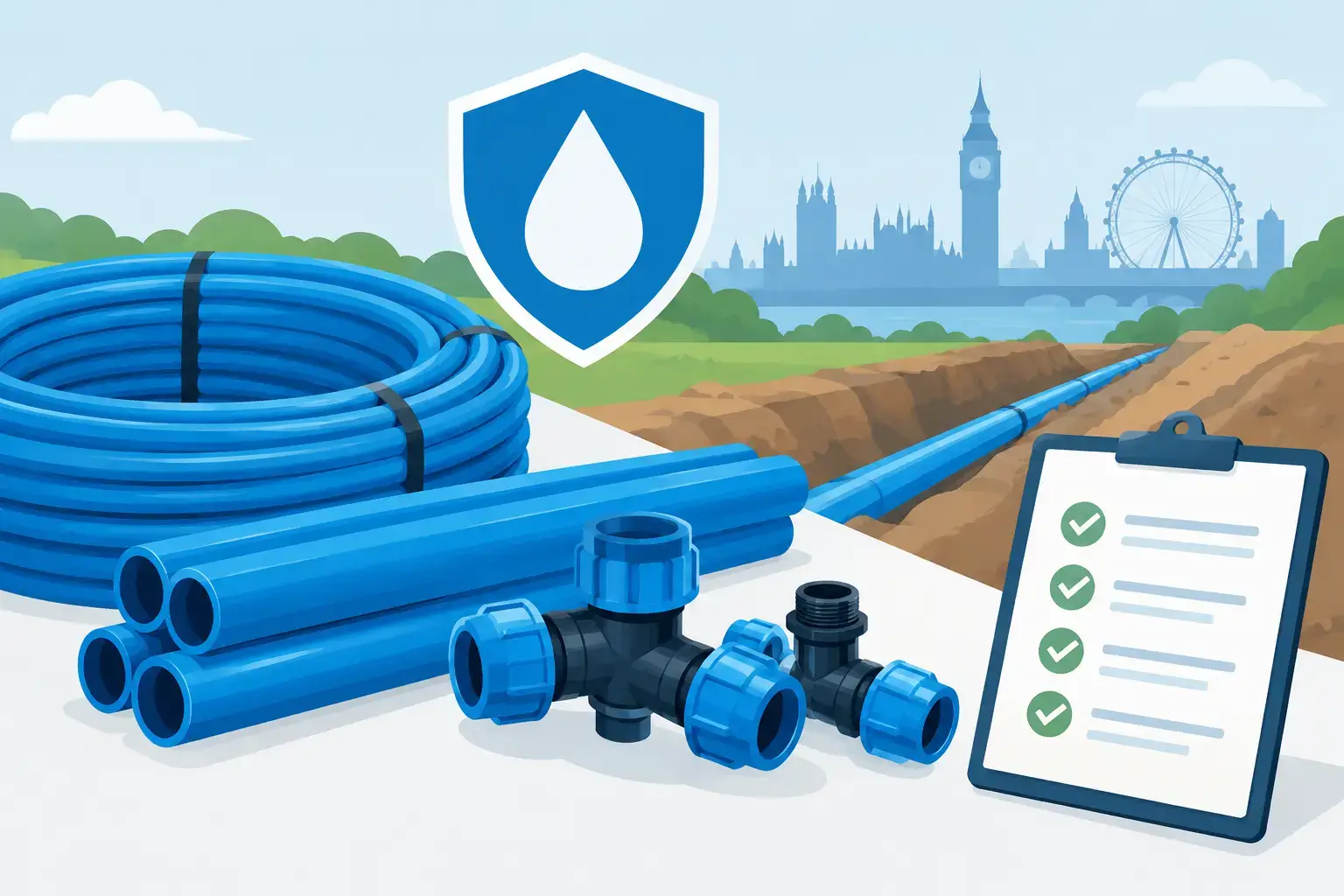
A new water service rarely goes wrong because the installer cannot join pipe. Problems usually begin earlier: the wrong approval, an undersized diameter, incompatible fittings or a pipe choice that does not match the site conditions. This WRAS-approved MDPE selection guide sets out what to check before ordering pipework for a domestic, commercial or agricultural cold-water supply.
MDPE is widely used for underground potable-water services because it is flexible, corrosion-resistant and supplied in practical coil lengths. However, blue MDPE is not automatically the right answer for every job. Approval status, pressure rating, outside diameter, connection type and the requirements of the local water supplier all need to line up.
WRAS approval confirms that a product has been assessed as suitable for contact with wholesome water under the UK Water Supply (Water Fittings) Regulations and associated Scottish Byelaws. For a potable-water installation, this gives installers, property owners and procurement teams confidence that the material is appropriate for its intended use.
The detail matters. Approval applies to a particular product and, in some cases, to defined operating conditions. Do not assume that every blue polyethylene pipe, compression fitting, valve or adaptor carries the same approval simply because it is used on a water main. Check the product description and technical documentation for the pipe and every component that will be in contact with drinking water.
WRAS approval is not a substitute for correct installation. Pipe depth, bedding, protection, service identification and backflow prevention can still be controlled by the Water Regulations, the water supplier’s conditions and the project specification. On a new connection, the local water company may also specify its preferred pipe size, boundary-box arrangement or meter assembly.
The first decision is whether the pipe will carry potable water. If it supplies a dwelling, a commercial building, a livestock drinking system or a cold-water tank used for domestic water, choose WRAS-approved pipe and compatible WRAS-approved fittings where required.
For irrigation, process water or a private non-potable system, the approval requirement may be different. Even then, using clearly identified blue potable pipe on a non-potable line can create confusion later. Where there is any risk of cross-connection, label services properly and follow the relevant separation and backflow protection requirements.
Consider where the pipe runs. A typical buried service from the boundary to a property has different demands from a pipe passing through a plant room, beneath a driveway or across agricultural land. Ground movement, vehicle loading, frost exposure, UV exposure above ground and the chance of future excavation all affect the installation method and accessories needed.
MDPE water pipe is measured by outside diameter, not bore. This is why a 25 mm pipe does not have a 25 mm internal waterway. Wall thickness reduces the internal diameter, and that wall thickness varies with the pipe’s pressure classification.
For many individual domestic supplies, 25 mm MDPE is a common choice. It is manageable in a coil, suits many standard service arrangements and can provide a practical flow rate over modest distances. Yet it is not automatically adequate. A long run, several bathrooms, a high-demand property or poor incoming pressure can make 32 mm pipe the better selection.
Larger diameters such as 40 mm, 50 mm and 63 mm are more commonly considered for larger properties, multiple units, commercial premises, agricultural distribution and longer private mains. Larger pipe can reduce friction loss, but it costs more, requires larger fittings and is less convenient to handle. The right choice depends on available pressure, required flow, total pipe length, elevation changes and simultaneous demand.
As a practical rule, do not reduce the pipe size simply to match an existing fitting or stop tap. Use a correctly sized adaptor where appropriate. Restricting a long supply run at the wrong point can leave taps, showers or appliances short of flow when demand is highest.
MDPE is available in different pressure ratings, often expressed in bar. Higher pressure-rated pipe generally has a thicker wall, which affects its internal bore and therefore its flow performance. Select a rating that meets the operating pressure and the installation specification rather than treating the highest rating as a universal requirement.
Check the pipe marking before installation. A correctly marked pipe should identify key information such as manufacturer, size, material and pressure classification. This is useful for site records and makes future alterations less uncertain.
Blue MDPE is the recognised choice for potable-water pipework in many UK installations. It helps distinguish drinking-water services from black pipe commonly used for irrigation or other non-potable duties. Some approved potable pipe may have a different colour arrangement, so rely on product markings and approval details rather than colour alone.
Coil length is worth planning before placing an order. A longer coil can reduce the number of underground joints, which is usually beneficial on a buried service. It also needs more room to transport, uncoil and position safely. On a confined residential site, shorter coils or planned joint locations may be more practical, provided the fittings remain accessible where required and are installed correctly.
MDPE should be handled carefully in cold weather. The pipe becomes less flexible at low temperatures, so avoid forcing tight bends or attempting to straighten a coil aggressively. Follow the manufacturer’s minimum bend-radius guidance and use suitable bends or elbows where the route demands a sharper change of direction.
A reliable water main is a system, not just a length of pipe. Compression fittings are widely used with MDPE and are available as straight couplers, elbows, tees, reducers, stop taps and transition adaptors. The fitting must match the pipe outside diameter exactly: a 25 mm fitting is for 25 mm outside-diameter pipe, not an assumed internal measurement.
Where MDPE joins copper, brass-threaded components, a boundary box, a meter assembly or internal pipework, select the correct transition fitting for both materials and thread type. Do not mix imperial and metric sizes by guesswork. The components can appear close enough to fit but still create a poor seal or an unreliable connection.
Use inserts where the fitting manufacturer specifies them. An insert supports the end of the MDPE inside a compression joint and helps the pipe maintain its shape under compression. Cut the pipe square, remove burrs, check the pipe end is clean and push it fully home before tightening. Overtightening is not a cure for a badly prepared joint.
For potable water work, verify the approval status of valves, fittings and flexible connectors as well as the pipe. This is particularly relevant where a system transitions indoors, where different materials and components are often brought together.
A buried MDPE supply needs suitable excavation, a clean bedding material where necessary and protection from sharp stones or construction debris. The route should be planned to avoid avoidable damage and to maintain the required separation from drainage, gas and electrical services. Where services cross, follow the project specification and utility guidance rather than improvising on site.
Pipe should generally be laid at a depth that provides frost protection and reduces the risk of accidental damage, subject to local ground conditions and water-company requirements. A warning tape above the pipe can help identify the service during future excavation. Where pipe passes beneath driveways or areas with vehicle loading, additional protection or ducting may be required.
Before covering the trench, pressure-test the installation in line with the relevant method and inspect every joint. Flush the service as required before it is brought into use. Photographing the route and recording its depth, diameter and connection locations can save considerable time when future work is needed.
Before adding MDPE to the basket, confirm the supply use, required pipe diameter, pressure rating, coil length and full route length. Include enough pipe for risers, entries into the building and sensible allowance, but do not create unnecessary joints simply to use up offcuts.
Then check that each fitting matches the pipe’s outside diameter and that potable-water components carry the necessary approval. Add practical installation items at the same time: pipe inserts, stop taps, adaptors, ducting or protection, warning tape and any chamber or boundary-box components specified for the connection.
For trade buyers managing several jobs, keeping pipe and fittings within one compatible system reduces site delays and avoids the cost of returning unsuitable parts. Speedy Plastics stocks WRAS-approved MDPE water pipe and the associated fittings needed for straightforward supply installations, with competitive VAT-inclusive pricing and fast UK delivery options.
The best MDPE choice is the one that suits the actual service, not simply the cheapest coil or the diameter already on the van. Check the approval, size the run for realistic demand and order the complete compatible system before the trench is open.









 Sign in
