 Speedy UK Deliveries
 100% SECURE PAYMENT
 VOLUME DISCOUNTS
 Contact us
Speedy UK Deliveries100% SECURE PAYMENTVOLUME DISCOUNTSContact us
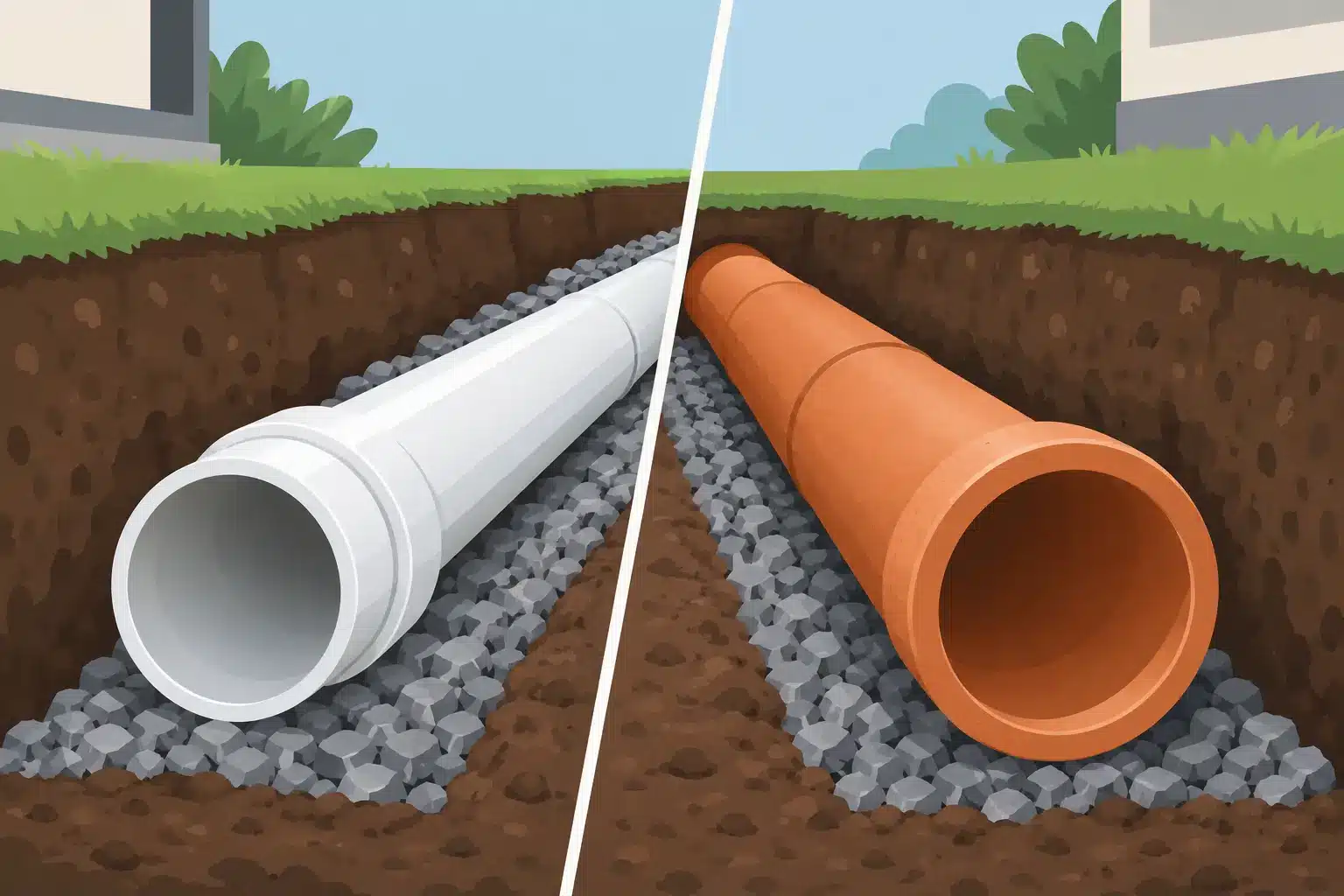
A drainage replacement often begins with an exposed, cracked run of old pipe – and a decision that affects the excavation, fittings, labour and future maintenance. PVC versus clay drainage is not simply a choice between modern and traditional materials. The right answer depends on the pipe’s location, loading, connection details, site conditions and whether you are extending an existing system or installing a new one.
For most domestic underground drainage work, plastic pipe is the practical default because it is light, readily available and quick to assemble. Clay still has a place, particularly where its compressive strength, chemical resistance or compatibility with an existing clay network makes it the better engineering choice. Assess the complete installation rather than judging either material by pipe cost alone.
PVC underground drainage pipe, commonly supplied as 110mm for domestic foul and surface water systems, is lightweight and uses push-fit socket joints with rubber seals. It can be cut on site, carried easily around restricted access and connected to a wide range of bends, branches, gullies, rodding points and inspection chambers. For extensions, garden drainage alterations and replacement runs, these practical advantages can reduce installation time considerably.
Vitrified clay drainage is a fired ceramic product, normally used in more demanding buried drainage applications or to match established networks. It is significantly heavier than PVC and requires more careful handling and lifting. Clay pipe is rigid, durable and highly resistant to abrasion and many aggressive effluents, but installation is less forgiving where the trench line, bedding or jointing is poor.
Neither material is automatically better in every ground condition. A correctly specified PVC system can give long service in domestic and commercial settings. Equally, a well-installed clay system can remain in service for generations. Failure is often caused by unsuitable bedding, inadequate falls, movement at connections or damaged joints rather than the pipe material itself.
PVC is usually the more efficient choice when labour time and access matter. A 110mm plastic pipe length can be moved and positioned by one person, while clay sections are heavier and may need mechanical assistance or extra operatives. This matters on rear-garden jobs, tight side passages and renovation projects where excavated material and pipework must pass through restricted spaces.
Plastic also offers a broad, compatible fitting range. Contractors can make direction changes, add a branch for a new soil stack or connect a gully without relying on specialist jointing methods. A clean cut, chamfered pipe end, correctly lubricated seal and fully inserted spigot are essential. Quick installation should not mean rushed installation: seals must be clean, pipe runs must be aligned, and access for rodding and inspection should be designed in from the start.
Clay systems take more planning. Their weight and rigidity can be beneficial once buried, but they demand accurate trench preparation and careful joint assembly. Dropping a clay pipe or striking it against a hard edge can crack it, even where the damage is not immediately obvious. Where clay is selected, allow for safe handling, correct lifting and sufficient space to work around the joint.
Clay has excellent compressive strength and performs well beneath substantial loads when designed and installed correctly. This is one reason it continues to be specified for certain commercial, industrial and adopted drainage applications. Its rigid nature, however, means it does not accommodate differential settlement in the same way as a more flexible plastic pipe system.
PVC pipe has a degree of flexibility, but that must not be mistaken for an ability to tolerate poor installation. Flexible pipes rely on properly compacted sidefill to support the pipe wall and distribute imposed loads. An over-dug trench, loose backfill or large stones placed against the pipe can lead to deformation or joint stress over time.
For either material, pipe class, cover depth, traffic loading and the trench detail need to be considered together. A driveway run, a pipe below a regularly used access route and a shallow connection near a building may all require different protection or specification from a standard garden drainage run. Follow the relevant manufacturer guidance, project drawings and Building Regulations requirements, and check any additional requirements where drainage will be adopted or connected under a utility provider’s rules.
A sound bedding layer provides continuous support beneath the barrel of the pipe. The pipe should not rest on socket joints, stones or hard spots. Granular bedding and sidefill are commonly used where specified, with compaction carried out in layers to avoid movement and voids.
This is particularly relevant when changing from clay to PVC. Do not assume the old trench formation is suitable simply because clay pipe was previously present. Remove damaged material, establish the required fall and rebuild the bedding where necessary. The new system is only as dependable as the ground supporting it.
Plastic push-fit joints are quick, watertight and easy to inspect during installation. They also make future alterations straightforward, provided the system uses compatible components and the pipe ends are properly prepared. PVC is a practical option for local repairs because short damaged sections can often be removed and replaced with repair couplings or adjustable fittings.
Existing clay drainage can be repaired locally, but matching diameters and joint types requires care. Older clay pipe sizes do not always align neatly with modern nominal plastic sizes, and pipe spigots, sockets and external diameters can vary by age and manufacturer. Purpose-made clay-to-plastic couplings are usually the sensible route, rather than forcing a connection or relying on excessive sealant.
Measure the actual pipe before ordering. Identify whether you are connecting to a clay socket, a clay spigot or a cut section of pipe, then select the appropriate adaptor or flexible coupling for the outside diameters involved. A connection that appears acceptable at ground level can leak once backfilled if it is unsupported, misaligned or installed on a damaged pipe end.
Root ingress is another area where the joint matters more than the headline material. Roots enter through gaps and displaced connections in both clay and plastic drainage. PVC’s sealed joints can help prevent ingress when installed correctly, while an older clay system with deteriorated joints may be more vulnerable. If repeat root blockage has occurred, a camera survey can establish whether the issue is a failed joint, fracture, poor fall or an obstruction elsewhere in the run.
Vitrified clay is inherently resistant to corrosion, abrasion and a wide range of chemicals. That can be valuable in applications involving abrasive flows or industrial discharge, subject to the full system design and discharge requirements. It is also unaffected by ultraviolet exposure when stored outside, although impacts can still cause damage.
PVC drainage is resistant to normal domestic foul water, rainwater and typical soil conditions. It does not rust and is not susceptible to the same corrosion mechanisms as metal systems. For standard homes, extensions and many commercial installations, it provides a durable and economical drainage solution. Where unusual chemicals, high temperatures or specialist effluents are involved, confirm that the selected pipework and seals are suitable for the duty rather than making a material choice on assumption.
Environmental comparisons deserve a measured approach. Clay is made from natural materials and can have a very long service life, but firing it requires significant energy and its weight increases transport and handling demands. PVC uses polymer materials, yet its lighter weight can reduce transport effort and it can be recycled through appropriate routes. Service life, local availability, excavation requirements and the likelihood of future repairs all influence the overall impact.
PVC usually offers a lower installed cost for routine domestic work. The pipe and fittings are competitively priced, stock is widely available, and reduced handling time can lower labour costs. A full plastic system also gives straightforward access to compatible chambers, gullies, bends and branches from one source.
Clay can cost more to purchase, transport and install, particularly where lifting equipment or additional labour is required. That does not make it poor value when a specification calls for it. On deeper runs, heavily loaded areas or projects that must connect into a clay network, the material’s properties may justify the extra outlay.
When comparing quotations, include excavation depth, bedding, backfill, fittings, connection adaptors, chambers and reinstatement. The cheapest pipe length can become the expensive option if it creates fitting difficulties or needs rework after backfilling.
Choose PVC for most domestic foul and surface water drainage where speed of installation, manageable handling and a wide fitting selection are priorities. It is particularly suited to new extensions, replacement pipe runs, garden rooms and straightforward repairs using standard 110mm underground drainage components.
Consider clay where the project specification requires it, where the existing network is clay and a compatible repair is preferable, or where loading and discharge conditions support its use. On larger commercial or infrastructure-related schemes, the decision should be made from the drainage design, required pipe classification and site-specific installation detail.
Speedy Plastics supplies trade-ready underground drainage pipework, fittings, inspection chambers and associated components for projects that need a practical, compatible system. Before ordering, confirm diameter, application, connection type and any specified approvals so the materials arrive ready for the work planned.
The best drainage material is the one that suits the ground, the loading and the connection you need to make – then receives the careful bedding, jointing and testing that keeps it working long after the trench has been reinstated.









 Sign in
