Speedy UK Deliveries
 100% SECURE PAYMENT
 VOLUME DISCOUNTS
 Contact us
Speedy UK Deliveries100% SECURE PAYMENTVOLUME DISCOUNTSContact us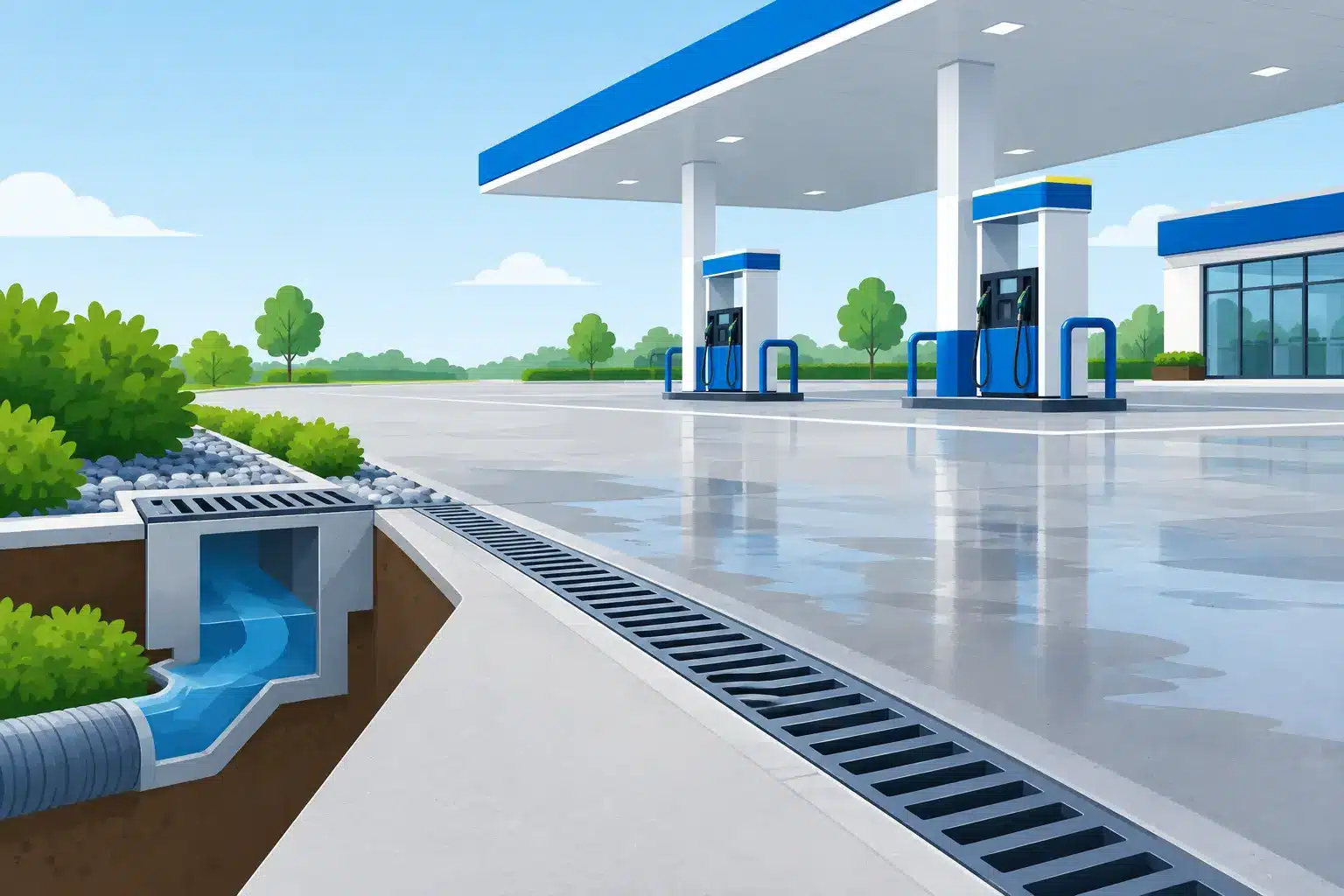
A forecourt that ponds around pump islands, entrance lanes or loading areas is more than an inconvenience. Standing water creates slip risk, carries contaminants towards surface water drains and can quickly undermine the finished surface. Effective forecourt drainage starts below the surface, with a planned route for every drop of runoff from the point it lands to its approved discharge point.
For petrol filling stations, vehicle depots, trade counters, workshops and commercial yards, the correct system is rarely just a channel and a length of pipe. Surface falls, traffic loading, pollution risk, discharge permissions and maintenance access all need to work together. Getting these decisions right at the design stage avoids disruptive remedial work once the surfacing is down.
A domestic driveway may only need to manage rainwater from a modest hardstanding. A working forecourt has higher runoff volumes, heavier vehicle loads and a greater chance that water will carry oil, fuel residues, silt or wash-down contaminants. The drainage design must therefore deal with both quantity and quality of water.
The first distinction is between clean and potentially contaminated runoff. Rainwater from a clean roof can often be directed to a separate surface-water system, subject to the site drainage strategy. Water running across fuelling areas, vehicle parking, delivery aprons and workshop entrances needs more careful consideration. It may require treatment before discharge, typically through an appropriately specified oil separator or other approved treatment measure.
Do not assume that every site needs the same interceptor arrangement. The right solution depends on the activity taking place, the drainage destination, local planning conditions and environmental requirements. For a new commercial development or altered petrol station layout, the drainage strategy should be agreed with the relevant designer, drainage authority and, where applicable, environmental regulator.
Drainage components cannot correct a poorly planned surface. Before selecting channels, gullies or underground pipework, establish where the water will naturally travel and where it must not be allowed to go.
Finished levels should direct runoff away from buildings, pump equipment, door thresholds and pedestrian routes. A gentle, consistent fall towards collection points is generally preferable to trying to force large areas of water into one low spot. This reduces localised ponding and helps keep channel runs manageable.
Forecourt layouts often have awkward constraints: underground tanks, existing services, kerb lines, HGV turning circles and fixed access points. These can make a simple linear drainage run impractical. In such cases, several channel runs, trapped gullies or carefully positioned catchpits may be more effective than one long channel at the bottom of the site.
The system also needs an intentional exceedance route. During intense rainfall, a blocked outlet or rainfall event beyond the design capacity can cause water levels to rise. Consider where that water will go without entering a building, crossing a public footway or reaching a sensitive area. This is a practical part of flood resilience, not an optional extra.
Separating drainage at source can reduce treatment requirements and make maintenance easier. Roof water should not be unnecessarily sent through an oil separator, while runoff from a vehicle service bay should not be connected directly to a soakaway or clean surface-water line.
Clearly identifying each drainage zone during design also helps on site. It reduces the risk of connecting the wrong pipe run when underground drainage is installed around several other buried services.
Channel drainage is commonly used across forecourt entrances, vehicle wash areas and the fronts of workshops or warehouses. It collects sheet flow along a defined line and directs it into the underground drainage system. The channel must be selected for the expected load, installed on a suitable concrete surround and fitted with a grating appropriate for the location.
Pedestrian-only areas may suit lighter-duty systems, but access roads, delivery bays and refuelling areas need a channel and grating specification capable of carrying the anticipated traffic. Think beyond the average car. If tankers, refuse vehicles, forklifts or delivery lorries will cross the channel, specify for that loading from the outset.
Gullies are useful where water collects at a defined low point or where a channel run would be unsuitable. They should include a suitable grating and trap arrangement where needed, with adequate access for clearing leaves, grit and debris. On operational sites, debris is not a minor issue. Tyre dirt, sand, litter and silt can quickly reduce capacity if collection points are not included in a maintenance routine.
Grating choice is also a safety decision. Slot width, heel resistance and surface finish matter around pedestrian routes, particularly where customers may be wearing footwear unsuited to a working yard.
Where runoff could contain hydrocarbons, an oil separator may form part of the site drainage design. Its role is to retain oil and separate contaminants from water before the discharge point. It is not a substitute for careful operational controls, spill procedures or regular maintenance.
Separator selection must match the site use and required treatment standard. Factors include the drained area, likely rainfall flow, whether detergent or vehicle wash water is present, and the approved destination of the effluent. Wash-down water can need different treatment from simple rainwater runoff, so it should not be added to a separator system without checking the specification.
Silt management is equally important. Catchpits or silt traps installed upstream can reduce the sediment reaching pipework and treatment equipment. This protects the system, but only if chambers can be accessed and emptied. A separator buried beneath a finished forecourt without safe access for inspection and servicing is a future cost waiting to happen.
Spill protection should be considered separately from normal drainage. Fuel delivery areas and dispensing locations may need specific containment measures within the overall site design. Requirements vary, so use the approved drainage drawings and project specification rather than relying on a generic arrangement.
Once surface water is collected, it needs a reliable route through the site. Underground drainage pipework must be correctly sized, laid to the required gradient and protected from traffic loads. For many commercial surface-water applications, 110mm, 160mm or 200mm underground drainage systems are used, with the final diameter determined by the drainage calculation and layout.
Larger pipe is not automatically better. Oversizing can reduce flow velocities and allow sediment to settle, while undersizing risks surcharge during heavy rainfall. The useful answer is a calculated design that considers catchment area, rainfall allowance, pipe gradient, incoming flow from channels and the treatment equipment downstream.
Use compatible bends, junctions, couplers and access fittings from the same system where possible. Improvised connections create weak points and make future maintenance harder. Inspection chambers should be placed at changes of direction, junctions and sensible intervals on longer runs, giving drainage contractors a practical route for rodding, jetting and CCTV inspection.
Pipe bedding and backfill matter just as much as the fittings. Inadequate support can lead to movement, poor joint alignment and eventual failure under repeated vehicle loading. Follow the pipe manufacturer’s installation guidance and the project specification for trench formation, granular bedding, surround and compaction.
The final destination for forecourt runoff determines much of the design. Connection to an adopted surface-water sewer may require approval and a restricted discharge rate. On-site attenuation can hold water temporarily and release it at an agreed controlled flow. Depending on ground conditions and pollution risk, a suitably designed soakaway system may also be possible.
Soakaways are not a universal answer for commercial yards. Ground permeability must be assessed, groundwater protection considered and contaminated runoff kept out of infiltration systems unless an approved treatment strategy permits it. If the site has a high water table, clay soils or a history of flooding, attenuation and controlled discharge may be more suitable.
For below-ground storage, crate systems, geotextile membranes, impermeable liners and inspection access should be selected as one coordinated assembly. The surrounding ground, imposed loading and maintenance requirements all affect the correct specification.
Forecourt drainage is only effective while water can enter, travel through and leave the system. Set out a maintenance plan before handover, covering channel cleaning, gully emptying, chamber inspection and separator servicing. The frequency will depend on traffic, surrounding vegetation, site activity and the volume of sediment carried onto the surface.
A simple record of inspections, emptying and any spill incidents is worthwhile for commercial operators. It helps identify recurring blockages and demonstrates that drainage assets are being actively managed.
For trade buyers and installers, Speedy Plastics provides a practical range of underground drainage pipe, fittings, channel drainage, inspection chambers, land drainage components and water-management products to build compatible site systems. Specify the drainage route first, then select each component around the loading, flow and maintenance needs of the job. That approach keeps a forecourt working safely long after the first heavy downpour.