Speedy UK Deliveries
 100% SECURE PAYMENT
 VOLUME DISCOUNTS
 Contact us
Speedy UK Deliveries100% SECURE PAYMENTVOLUME DISCOUNTSContact us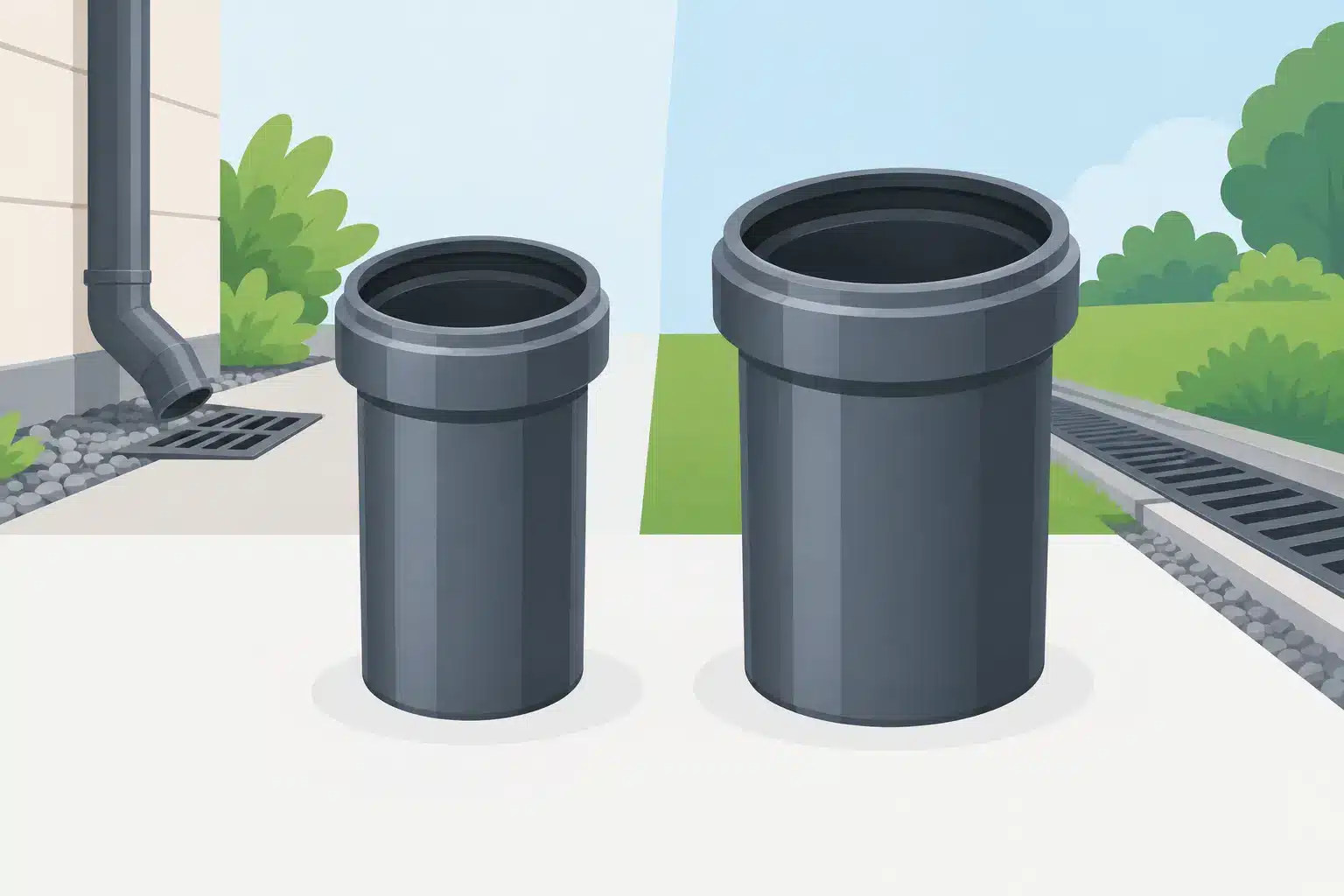
A drainage run that looks oversized on paper can cost more in excavation, fittings and reinstatement. One that is undersized can leave a development with poor capacity and expensive remedial work. The choice between 110mm versus 160mm drainage should start with the drainage design, the type of water entering the system and the connection point – not simply the diameter already on site.
For many domestic foul and surface-water installations, 110mm underground drainage is the familiar, readily available choice. A 160mm system becomes more relevant where several runs combine, flows are higher, a commercial site is involved or the design specifies a larger pipe. Both sizes have clear applications, but they are not interchangeable without checking the complete layout.
The stated size refers to the nominal diameter of the underground drainage pipe system. A 160mm pipe has a substantially larger cross-sectional area than a 110mm pipe. In simple terms, it can carry considerably more water at a comparable gradient, although actual performance also depends on the internal bore, pipe material, flow conditions, bends, access points and the quality of installation.
Using the nominal diameters as a guide, 160mm pipe has just over twice the cross-sectional area of 110mm pipe. That does not mean every project needs the larger size. Drainage pipes need enough flow to move solids in foul systems and enough capacity to manage expected stormwater in surface-water systems. The correct diameter is the one specified or calculated for the job.
110mm drainage is generally lighter to handle, simpler to cut and more economical across pipe, bends, branches and chambers. It is widely used for domestic foul drains, connections from soil stacks, gullies and modest private surface-water arrangements. 160mm pipe is larger, heavier and requires more room in the trench, but it gives extra capacity where the drainage network demands it.
For a typical house extension, replacement foul run or connection between a soil stack and an inspection chamber, 110mm underground drainage is commonly suitable where the design allows it. It is also frequently used for private surface-water pipework serving a small roof area, patio drainage or a limited number of gullies.
The benefits are straightforward. Components are widely used across domestic drainage work, so compatible bends, branches, couplers, access fittings, bottle gullies and inspection chambers are easy to specify as a system. Smaller pipe also means a narrower excavation than a larger line, subject to safe working requirements and the bedding detail.
A 110mm run still needs to be installed properly. The pipe must be laid to the gradient shown on the design, supported on suitable granular bedding where required, and kept free from excessive changes of direction. A larger pipe will not compensate for poor falls, badly made joints or inadequate rodding access.
For foul drainage, avoid assuming that a larger pipe is automatically better. If the pipe is oversized for the amount of flow and laid incorrectly, it may not achieve the self-cleansing performance intended by the design. This is why diameter, gradient and use must be considered together.
160mm underground drainage is often selected for larger developments, commercial premises, agricultural buildings, shared private drains and main runs that collect flow from several smaller branches. It may also be required where a consulting engineer, architect, local authority or water company has specified the size for the site.
Surface-water applications are a common reason to move up in size. Larger roof catchments, hardstanding, car parks and multiple drainage channels can produce a high volume of water during heavy rainfall. The pipework must be sized alongside gullies, channel outlets, attenuation, soakaways or the approved discharge point. Installing a 160mm line does not remove the need to assess where that water is going.
A 160mm run can also be appropriate where a drainage system is designed around a larger inspection chamber or connection. In this situation, trying to reduce the main line to 110mm simply because it is cheaper can create a restriction at the point where capacity matters most.
There are practical trade-offs. 160mm pipe takes up more storage space, is more difficult for one person to manoeuvre and can increase the cost of fittings, chamber connections and excavation. Check delivery access too, particularly on constrained residential sites. These are sensible costs where the design calls for greater capacity, not costs to add without a clear reason.
Foul drainage carries wastewater from WCs, basins, baths, showers, kitchens and utility areas. For ordinary domestic external foul runs, 110mm is the established size in many installations. The final arrangement must still comply with the approved drainage design and relevant Building Regulations requirements.
The number of appliances alone does not decide the pipe diameter. Pipe length, gradient, loading, branch layout, ventilation arrangements and the point of connection all matter. A block of flats, a hospitality venue or a workplace with multiple sanitary facilities may need larger downstream pipework once flows combine. A single dwelling normally presents a very different loading case.
Where an existing private drain is 160mm, retain that size on the relevant main run unless the design confirms a change is suitable. Any transition between diameters needs the correct adaptor or chamber connection, installed in the right direction for flow. Do not force mismatched fittings together or rely on sealant to make an incompatible joint work.
Surface water is where assumptions can become costly. A small domestic roof in one location may be adequately served by 110mm drainage, while a much larger roof, paved area or commercial yard may need 160mm pipework, additional attenuation or a different drainage strategy altogether.
The design should account for the catchment area, rainfall intensity, ground conditions, pipe gradients and the available outfall. If water is directed to a soakaway, the soakaway itself must be sized to suit site conditions and tested ground infiltration where required. If it connects to a public sewer or watercourse, permissions and discharge conditions may apply.
Channel drainage should be treated as part of the same system. A channel may have a 110mm outlet, but the downstream run must still have enough capacity for the contributing area. Equally, fitting a 160mm outlet to a channel will not solve ponding if the channel is poorly positioned or the falls direct water away from it.
Pipe diameter is only one part of a working drainage system. Every socket, coupling, bend, branch, rodding point and chamber inlet must suit the pipe size and material. Underground drainage systems are commonly supplied in PVCu, while twin-wall products are often used for larger-scale surface-water, highway, rail, agricultural and civil applications. Their connection methods and fittings are not automatically the same.
Before ordering, check whether dimensions are quoted as nominal size, outside diameter or internal diameter. This is particularly relevant when joining to older pipework, clay drainage, cast iron or a non-standard chamber. Measure the existing connection accurately and select a purpose-made adaptor where needed.
Inspection chambers also need attention. A chamber base may be configured for 110mm channels, 160mm channels or a combination of inlets. The chamber diameter, depth, cover loading and access arrangement should suit the installation. It is far easier to confirm this before excavation than after pipework reaches the chamber.
Correct installation protects the system more than a marginal increase in pipe size. Follow the manufacturer’s instructions and the project specification for trench depth, pipe bedding, sidefill, surround material and compaction. Keep joints clean, use the correct lubricant where applicable and make sure pipes are fully inserted without damaging seals.
Provide access for testing, cleaning and maintenance. Changes in direction, junctions and longer runs may require inspection chambers or rodding access in line with the approved layout. Test the drainage before backfilling so any issue with falls or joints can be corrected while the work remains accessible.
On sites with vehicle loading, shallow cover, poor ground or unusual ground conditions, the pipe class and protection detail are as important as diameter. A drainage contractor or engineer should confirm the arrangement where the installation falls outside a straightforward domestic trench.
Start with the approved drawings or drainage calculation. If the pipework serves one domestic foul run or a modest private surface-water layout, 110mm may be the right, cost-effective system. If flows combine, catchment areas are larger or the design identifies a 160mm main, choose 160mm throughout the relevant section and match every fitting and chamber connection accordingly.
Speedy Plastics supplies underground drainage pipework, fittings, chambers and connected water-management products in the sizes needed for domestic and trade projects. Ordering the full compatible system together helps avoid delays caused by one missing adaptor or incorrect chamber base.
The best purchase decision is usually the least complicated one: follow the design, allow for access and maintenance, and select the pipe size that suits the flow rather than the one that merely looks larger.